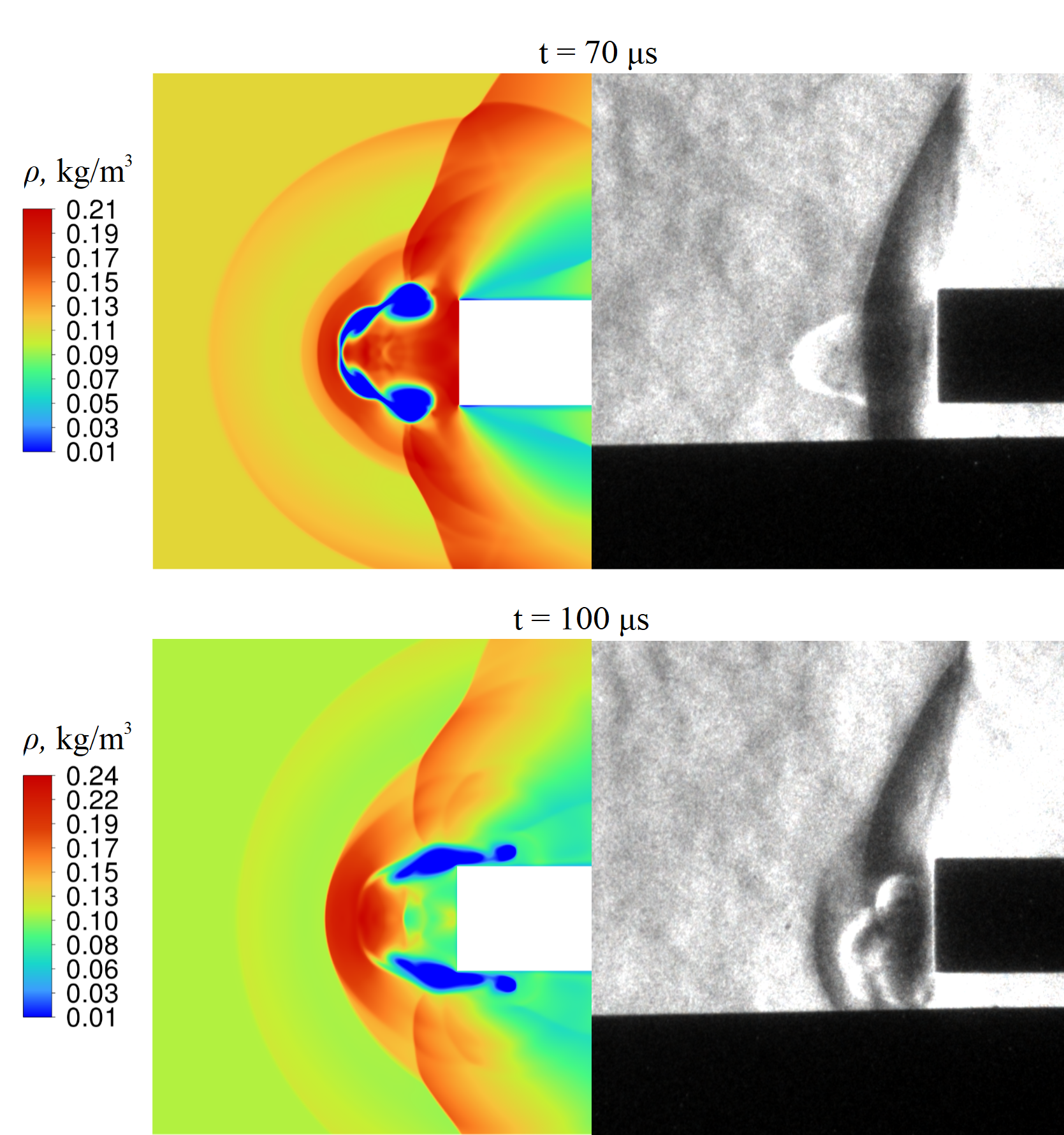
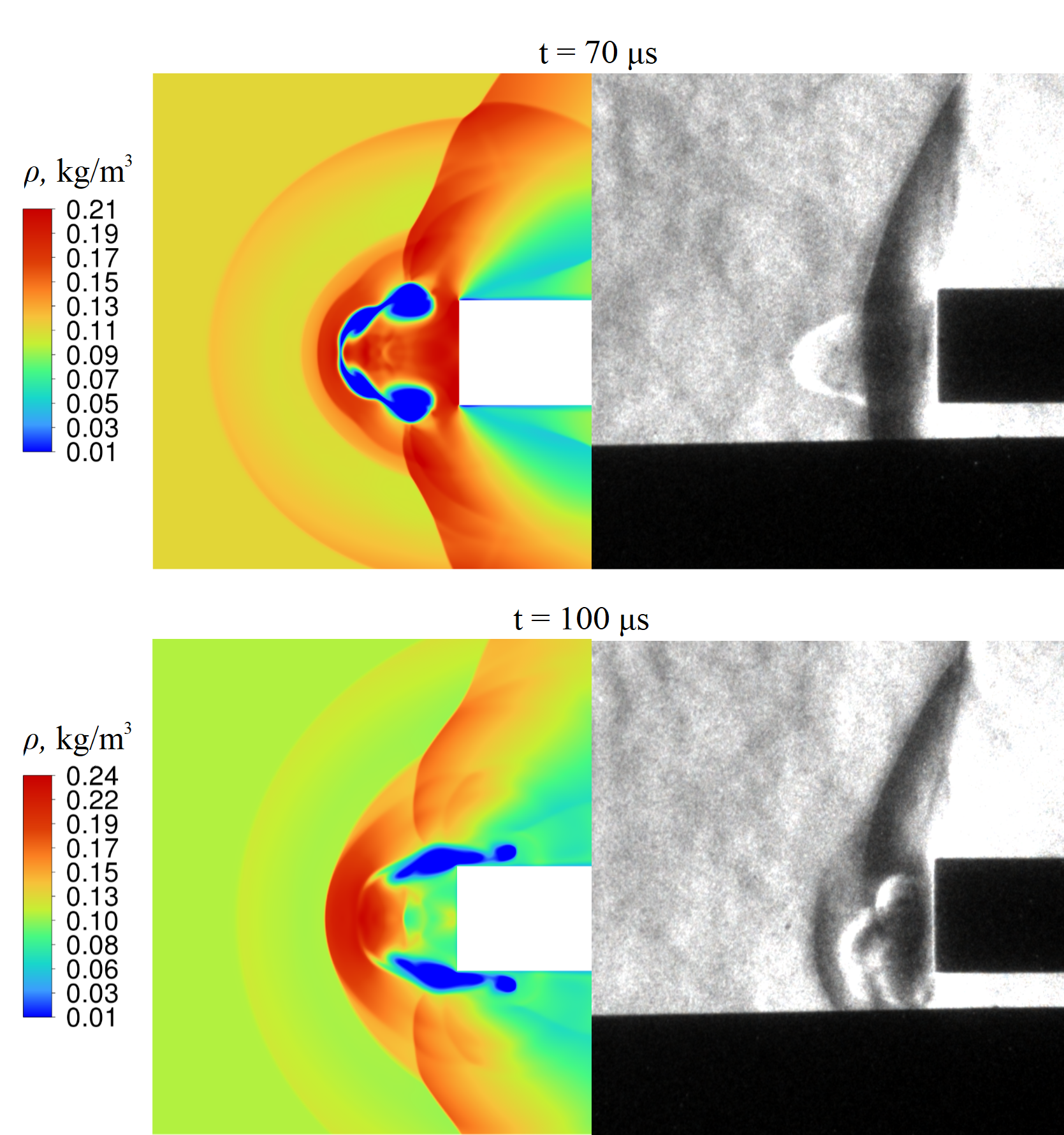
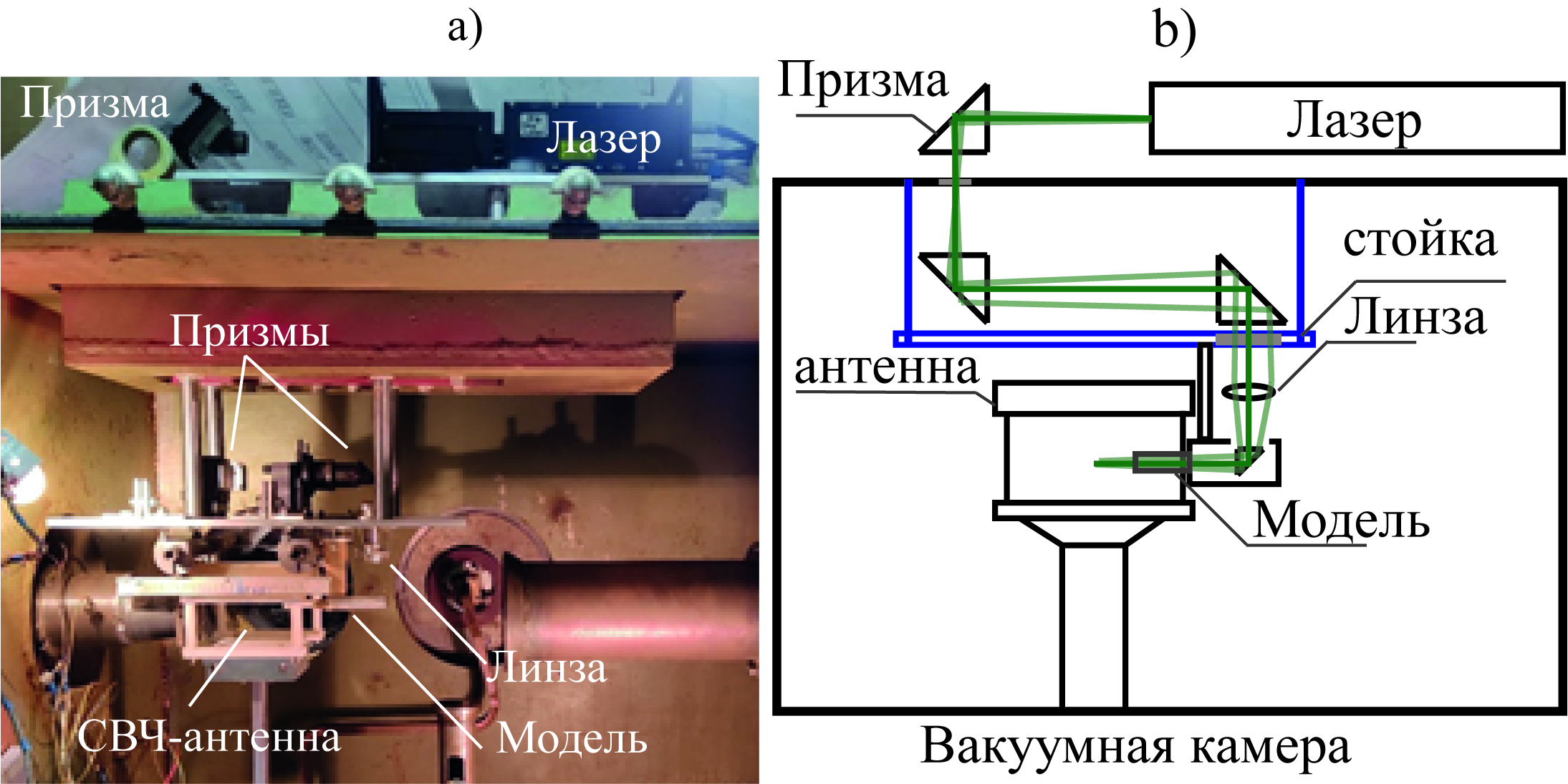
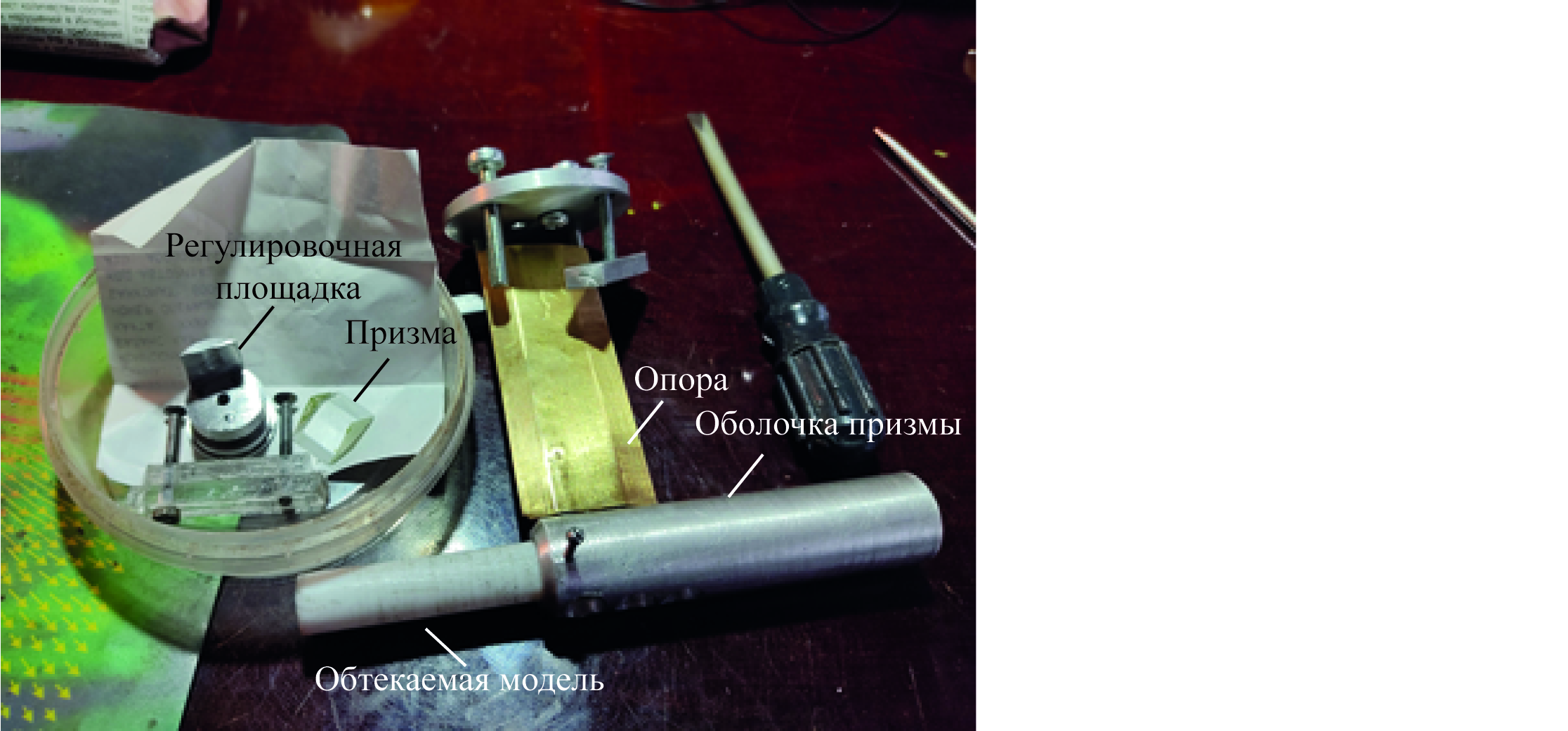
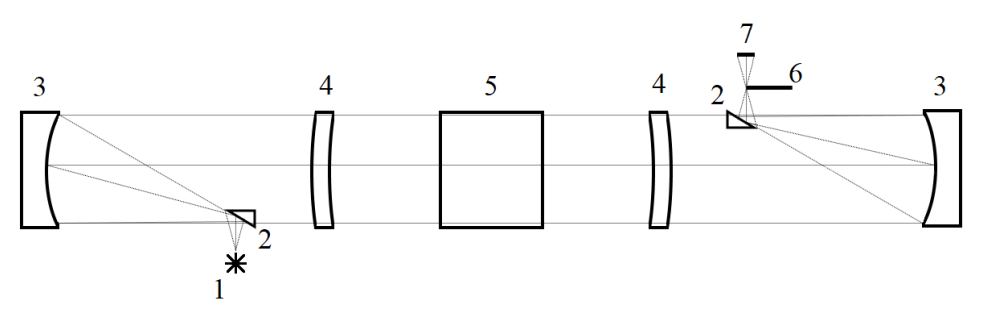
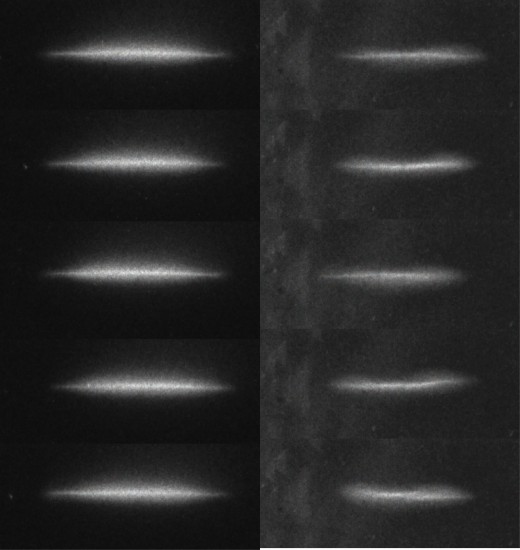
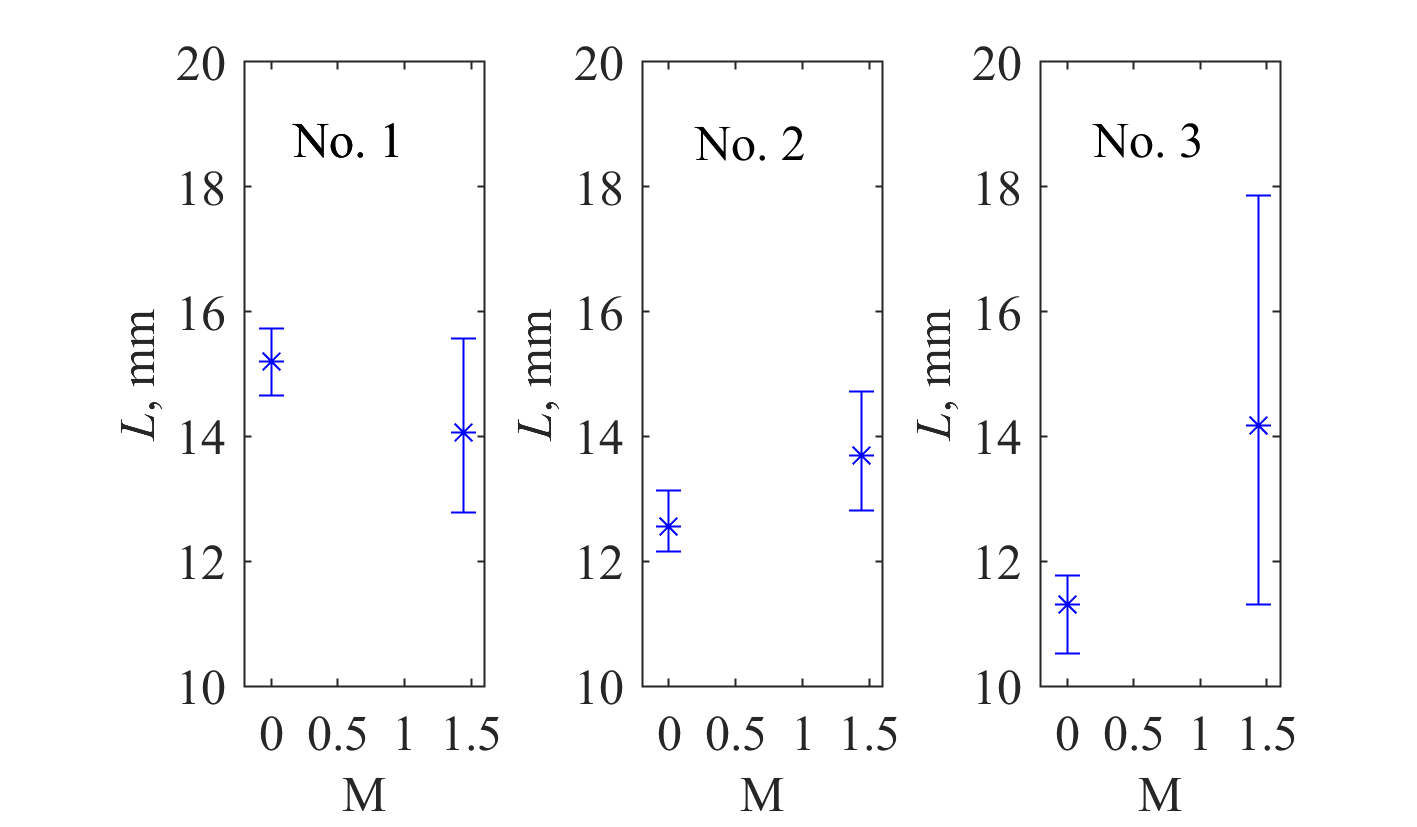
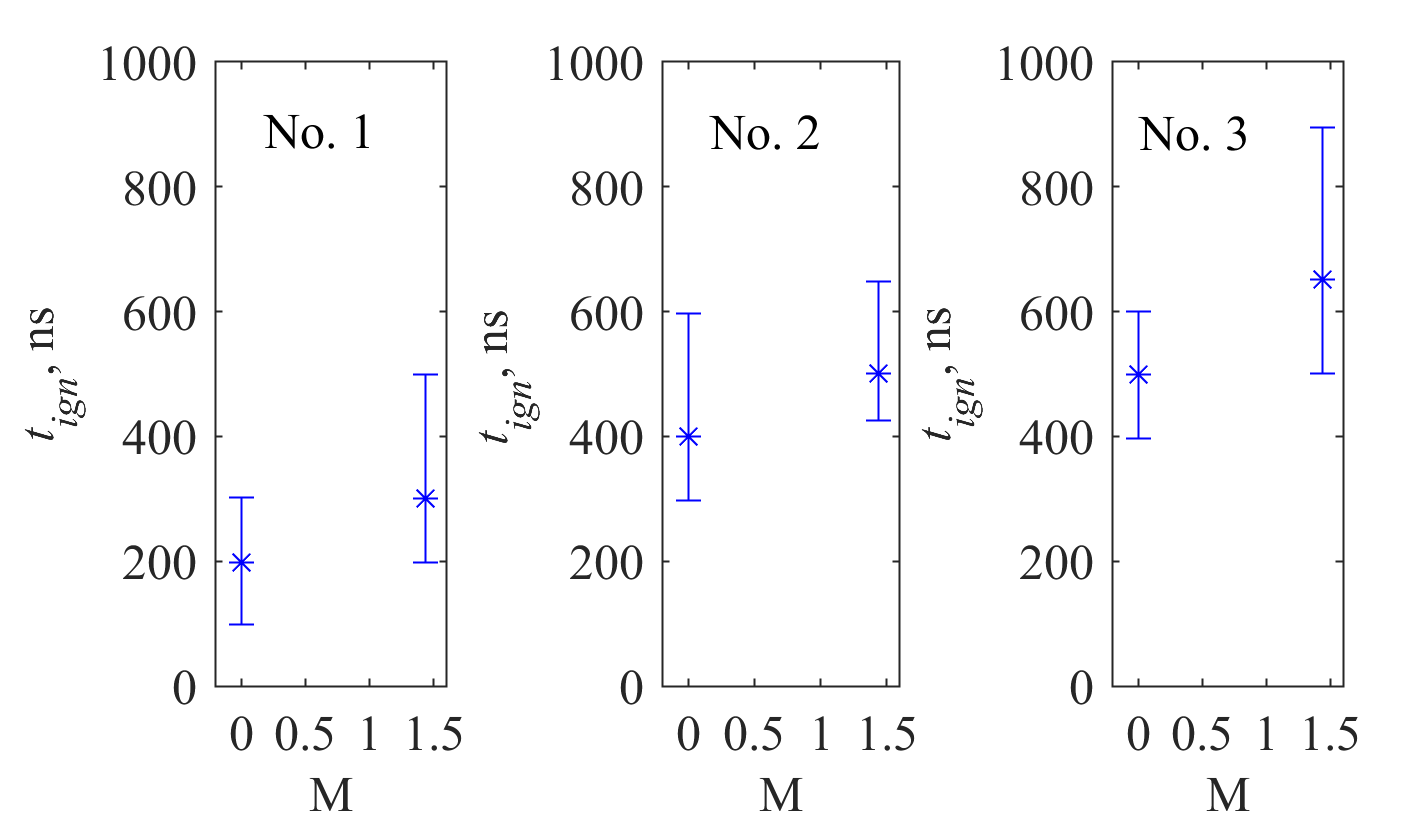
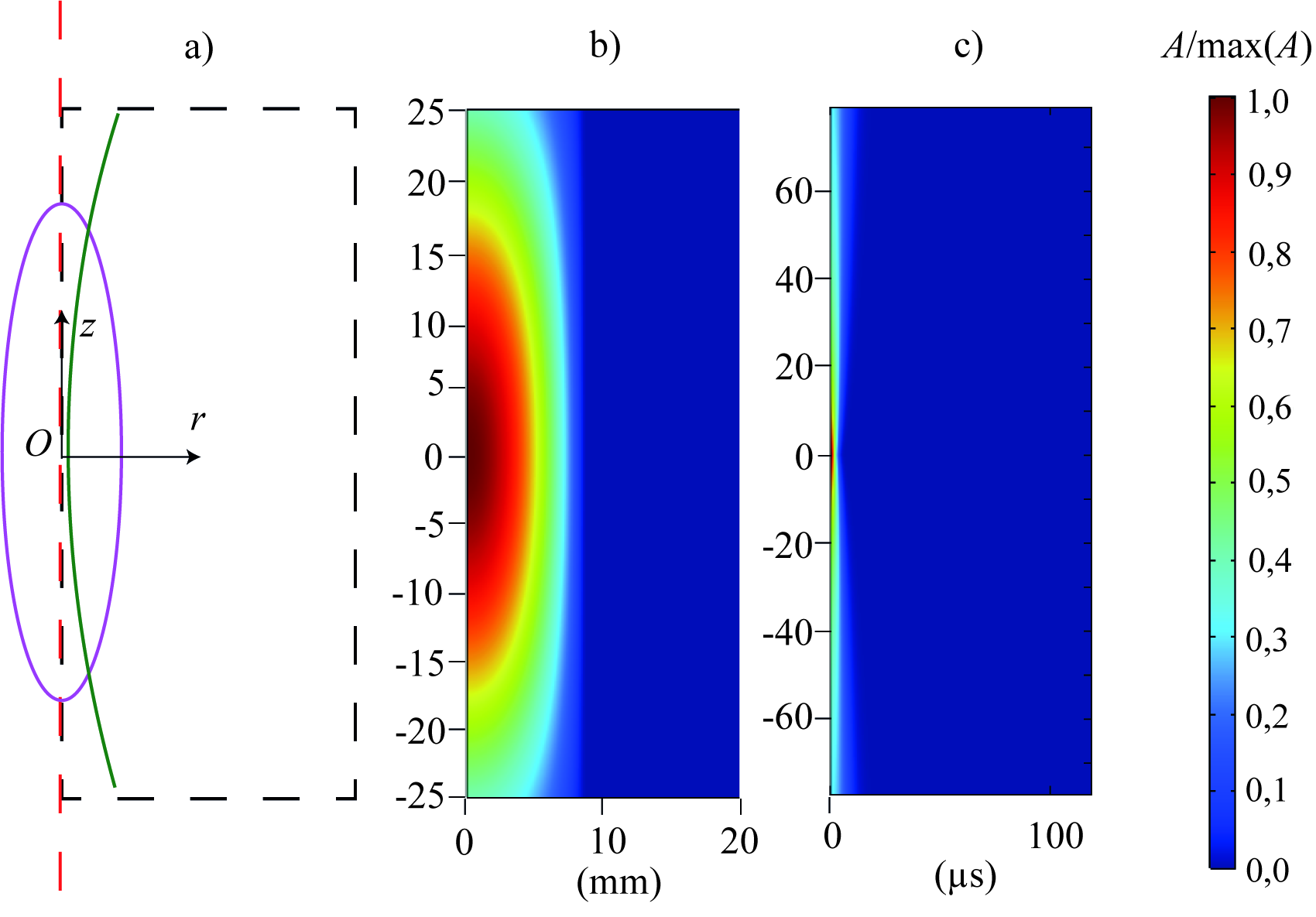
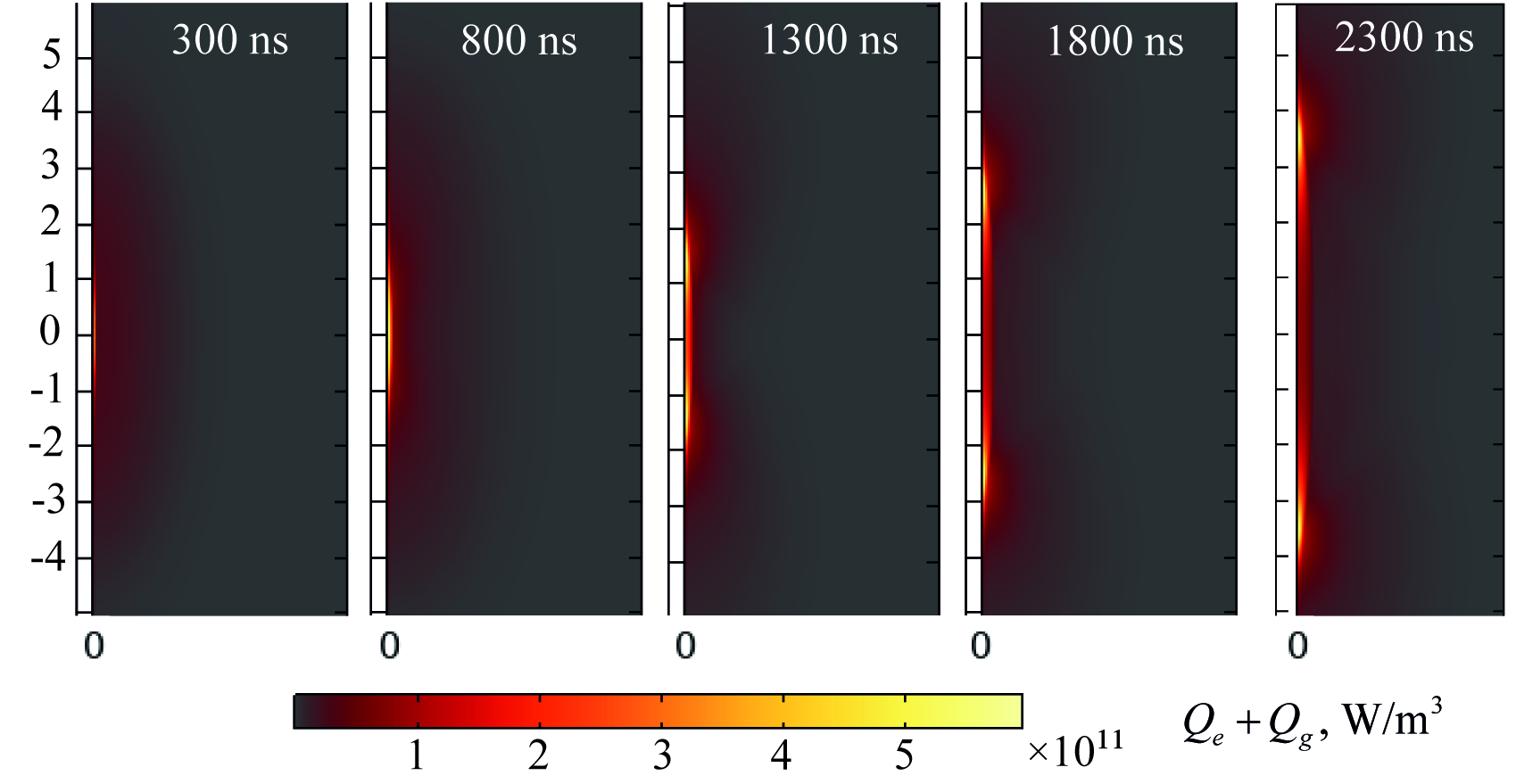
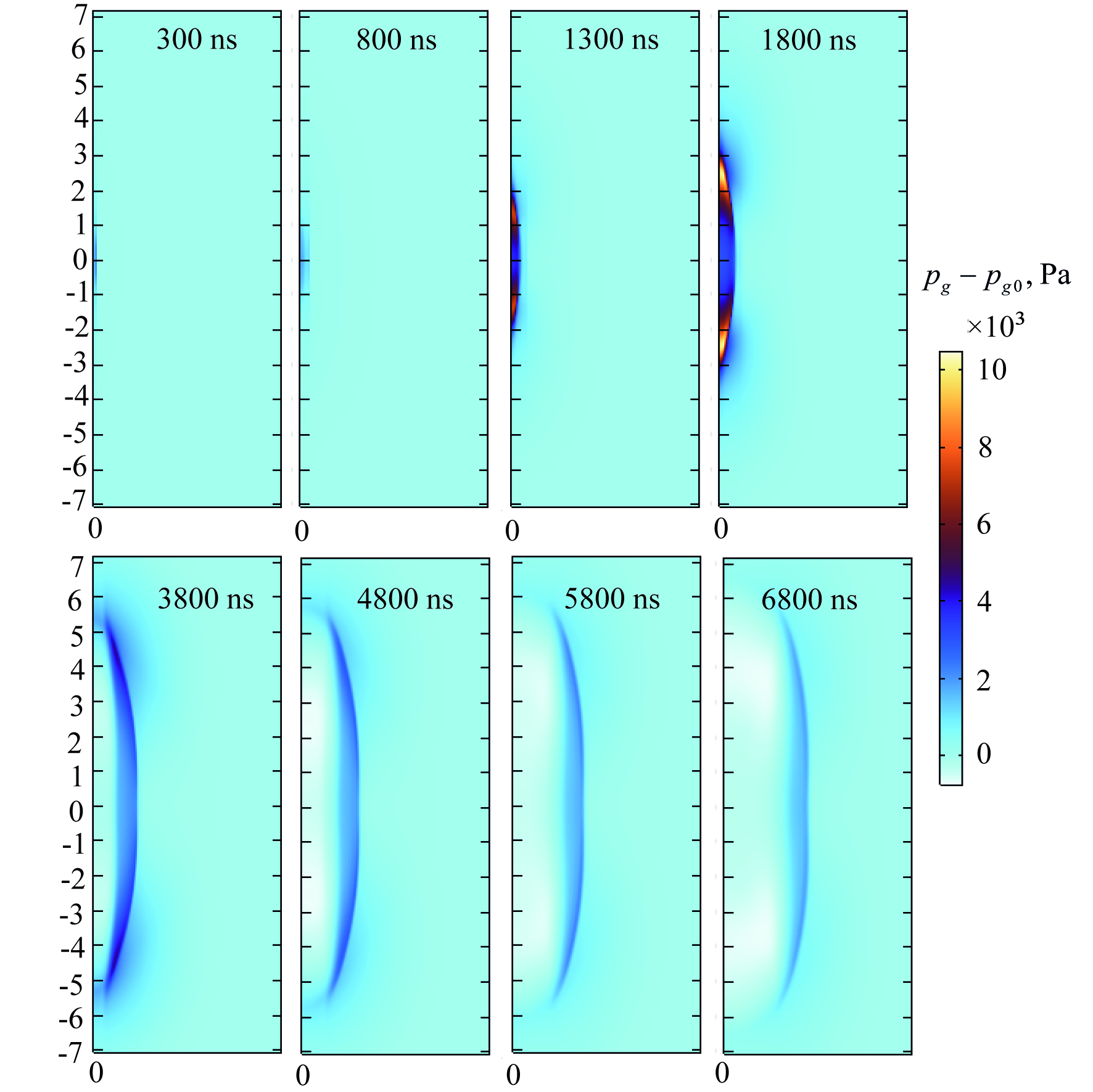
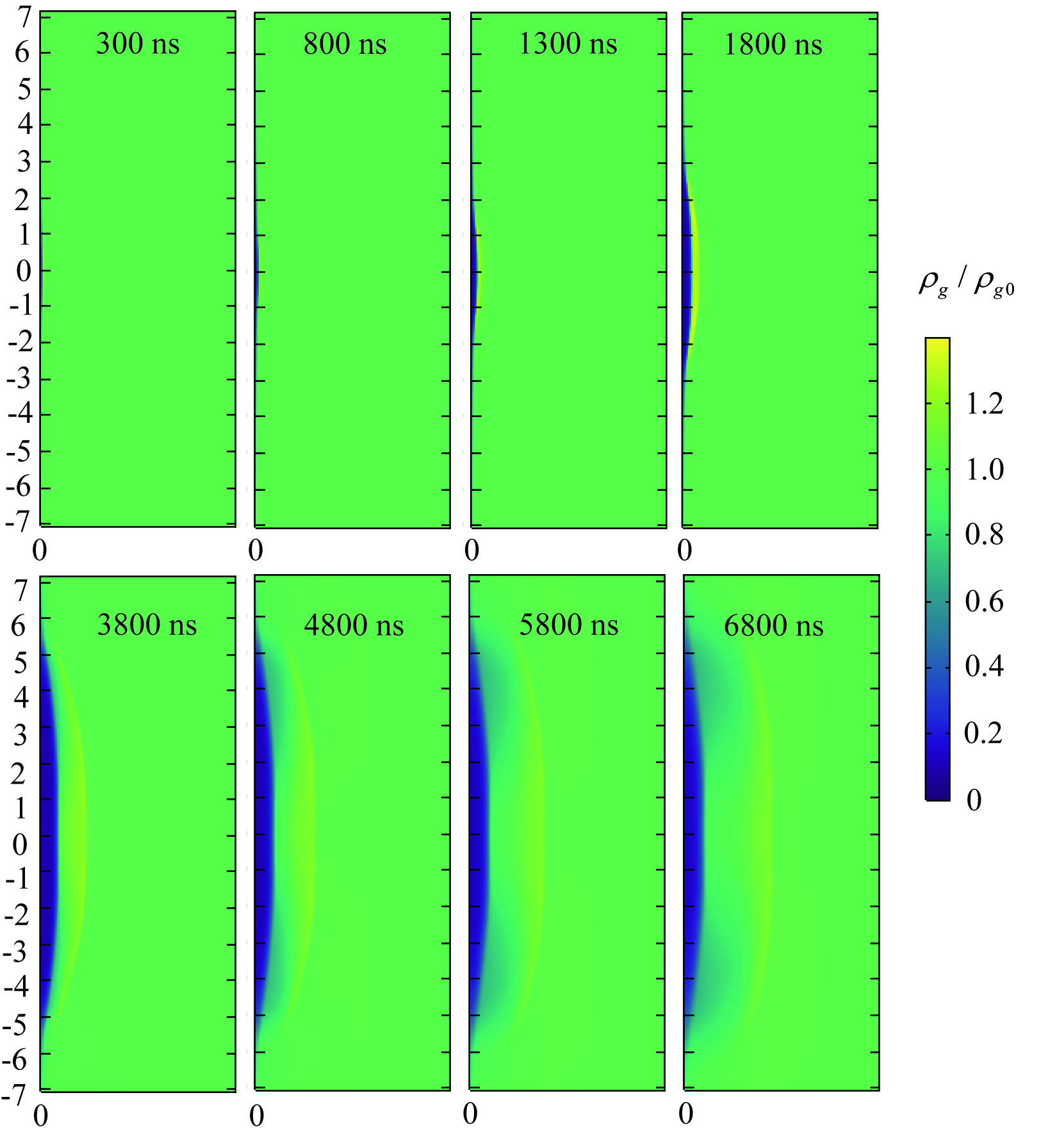
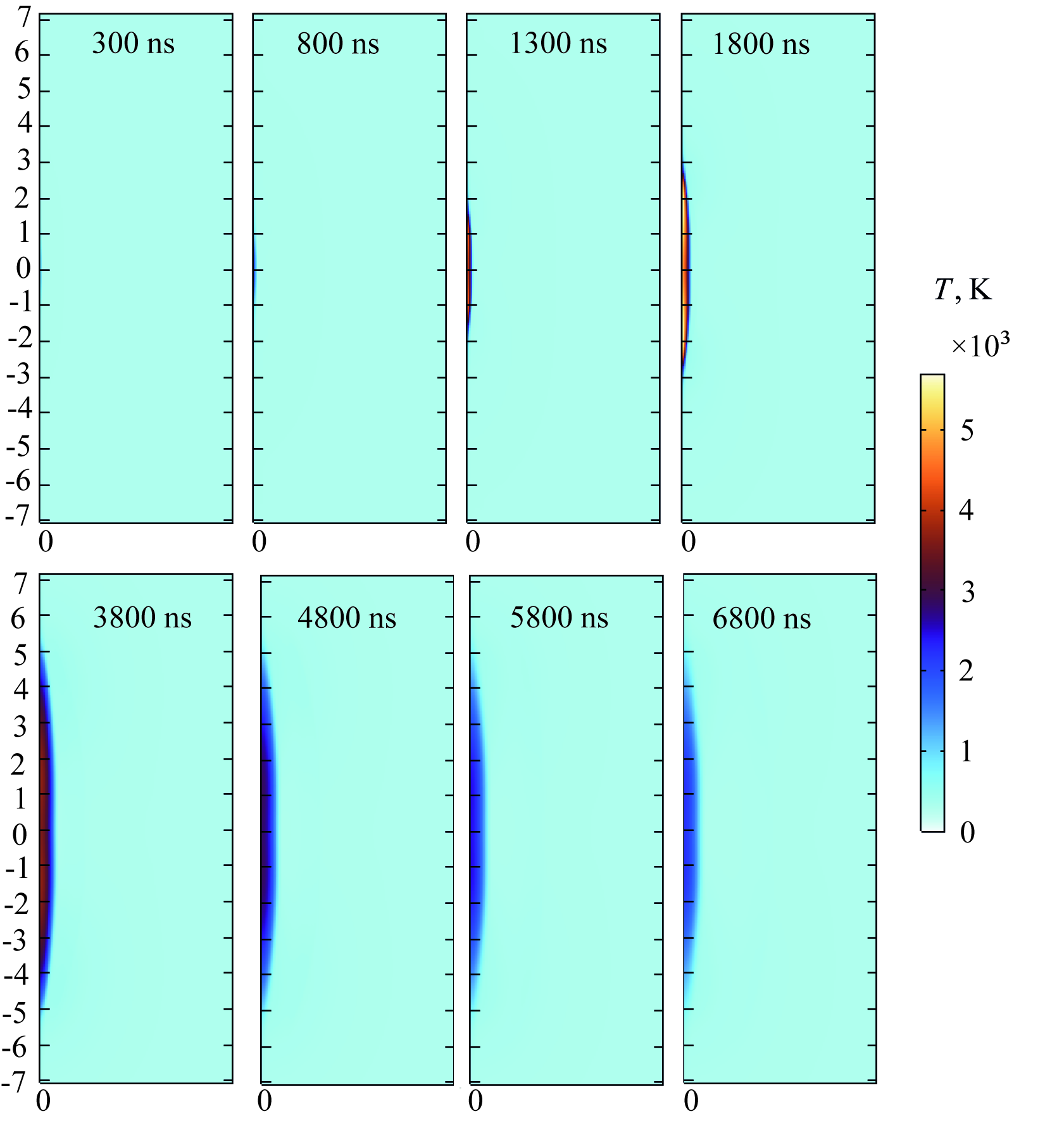
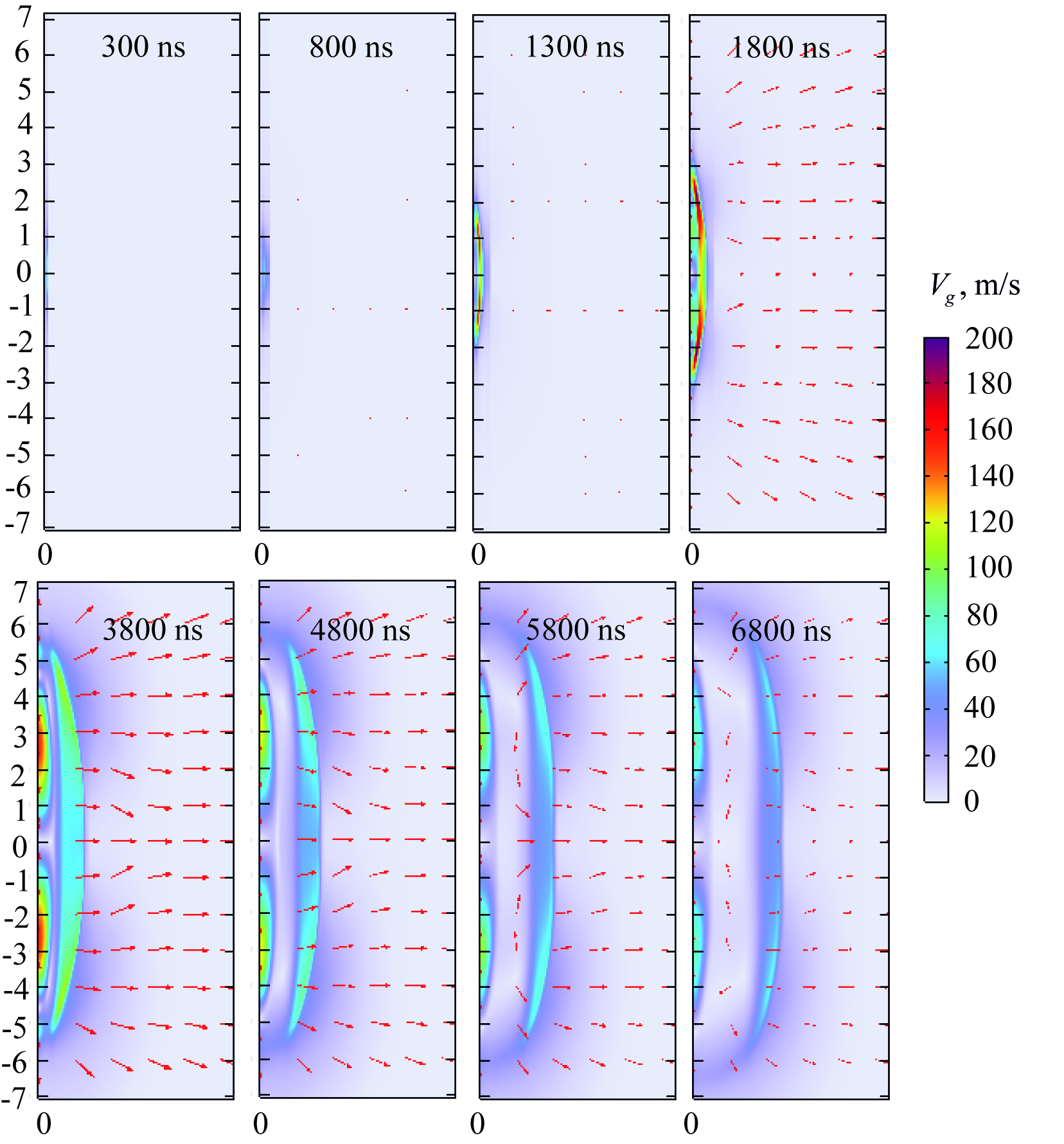
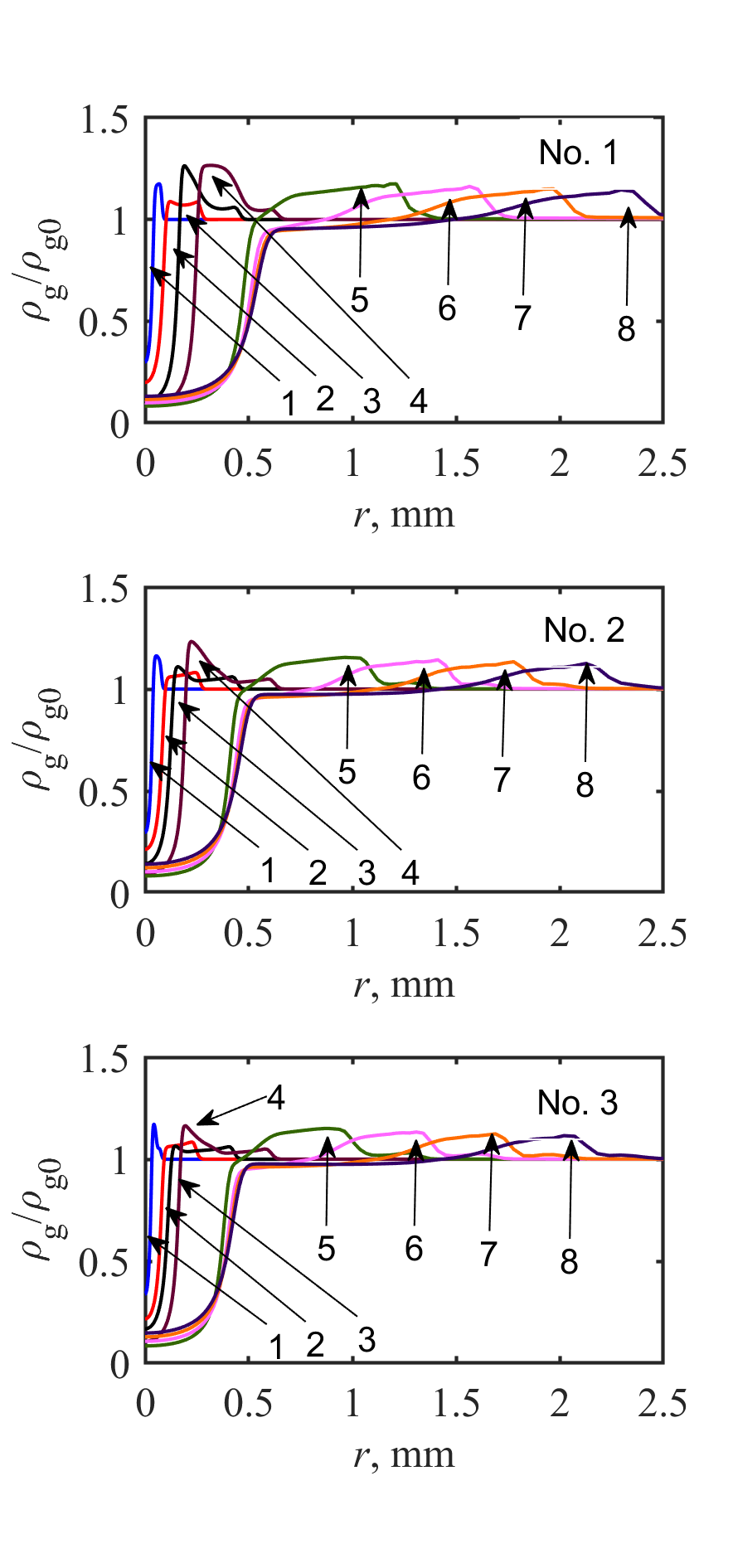
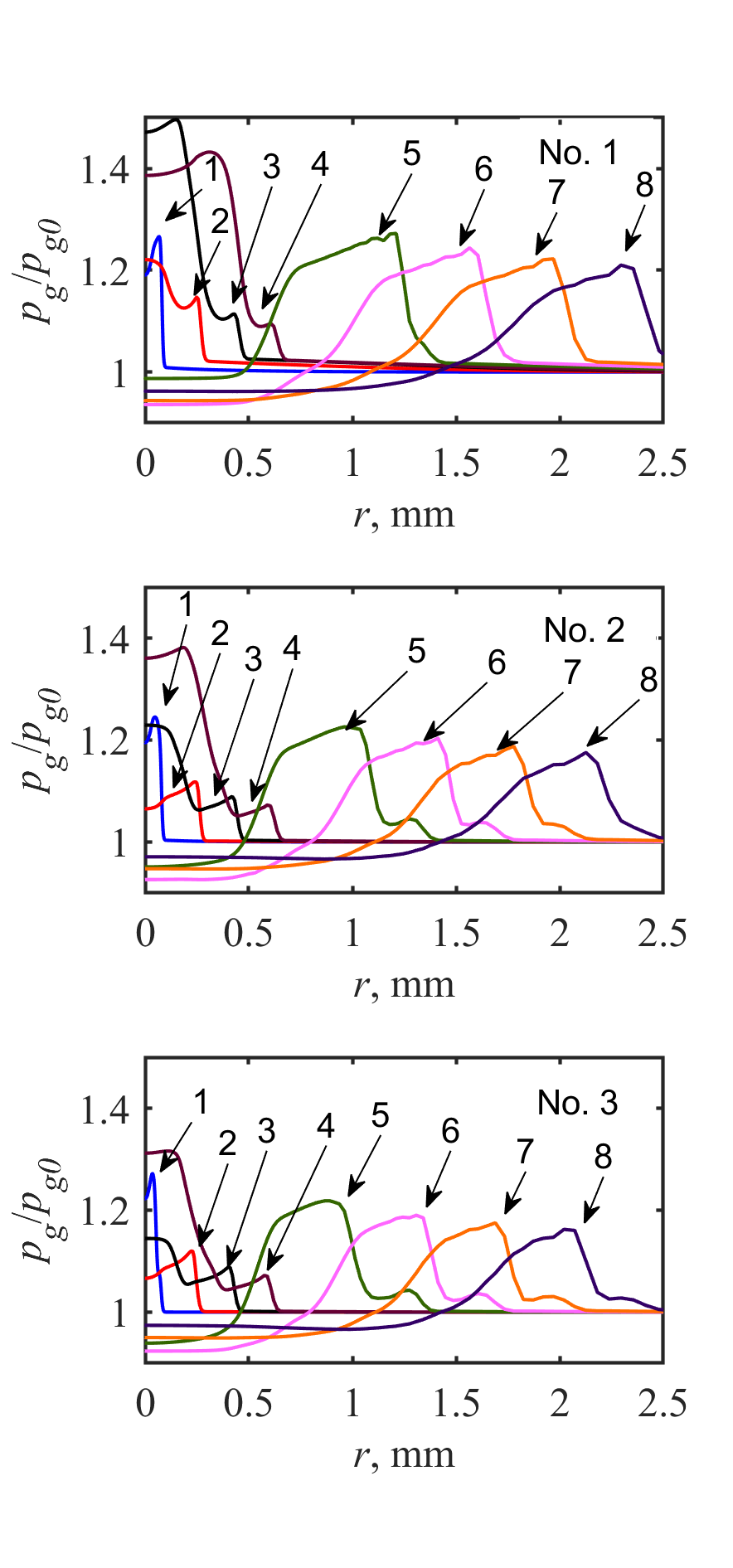
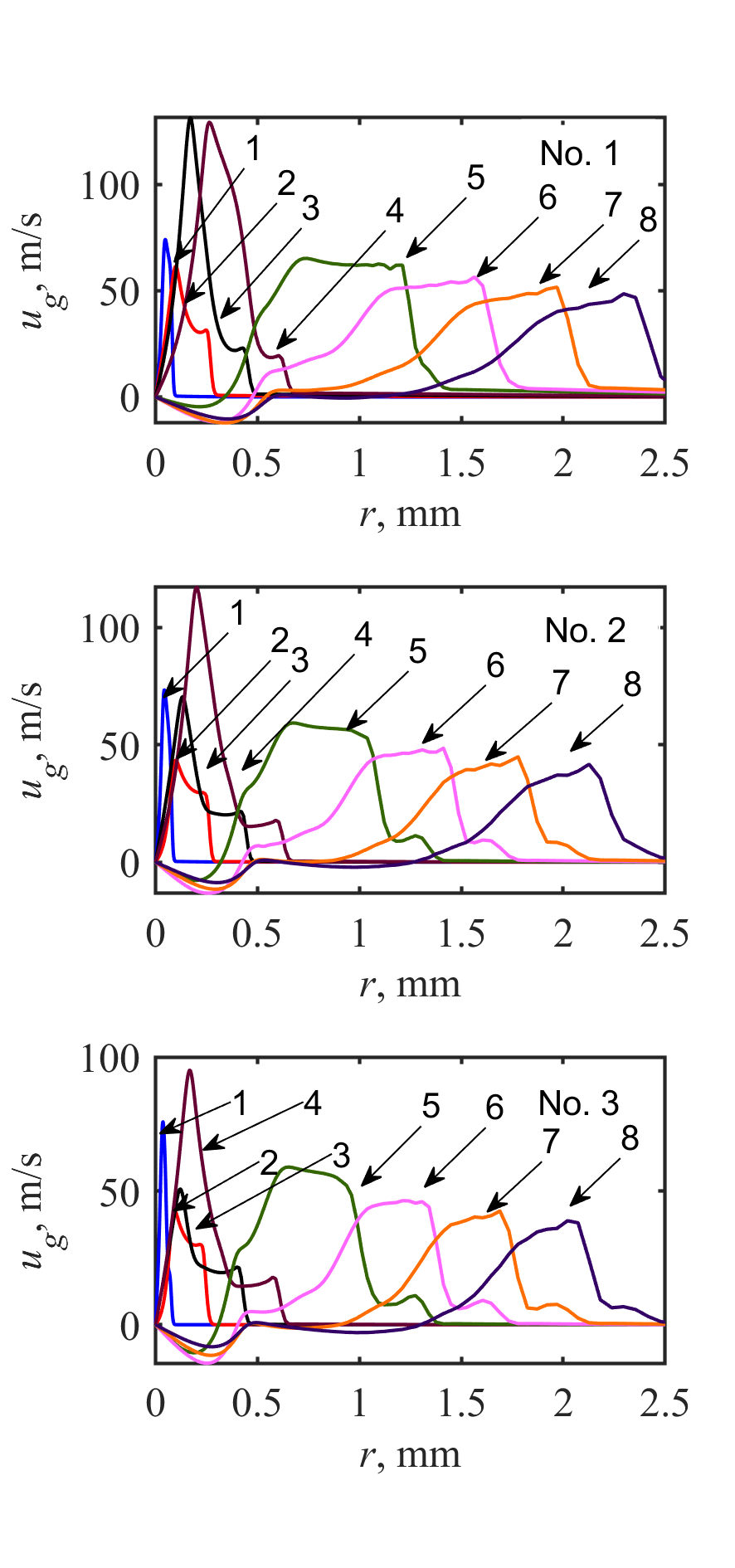
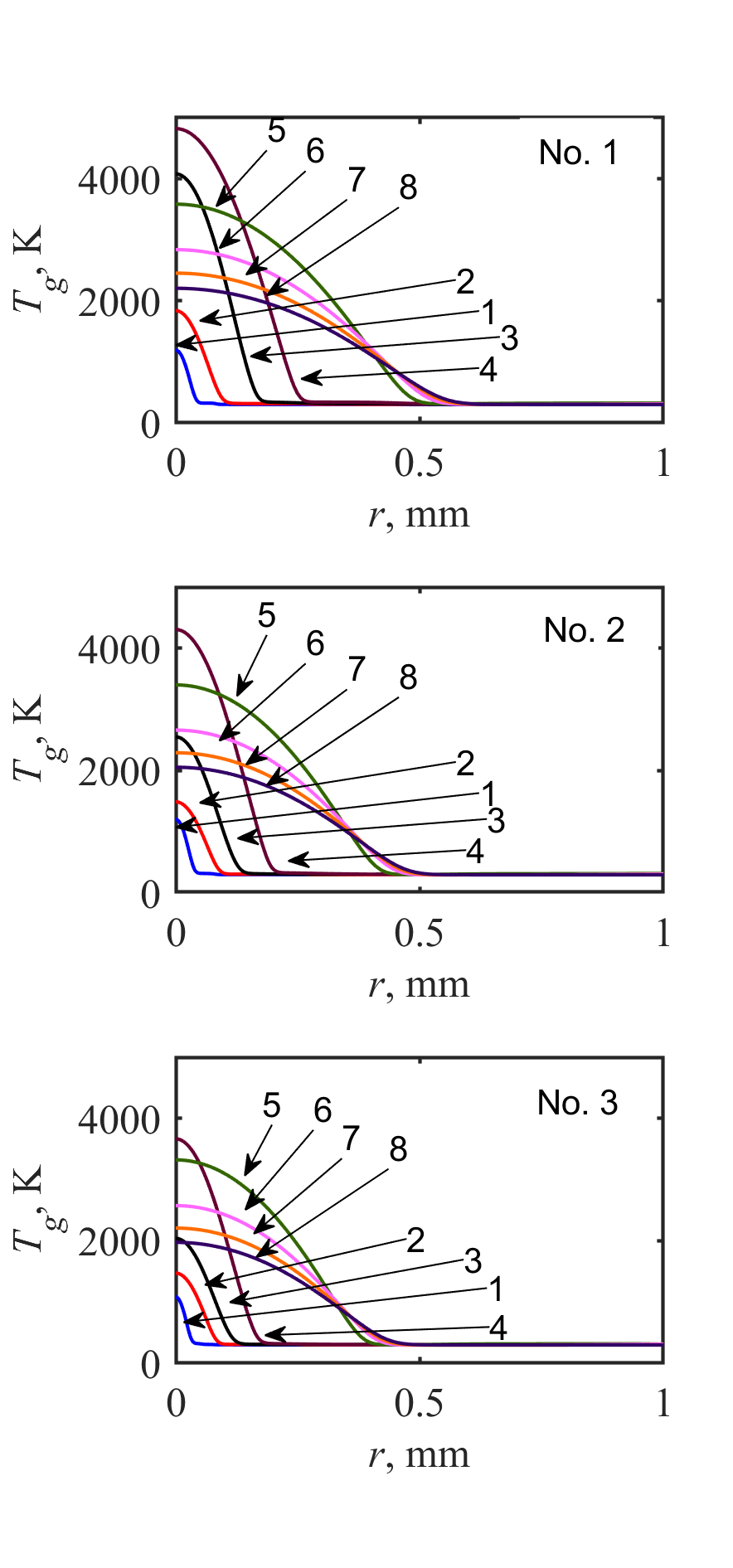
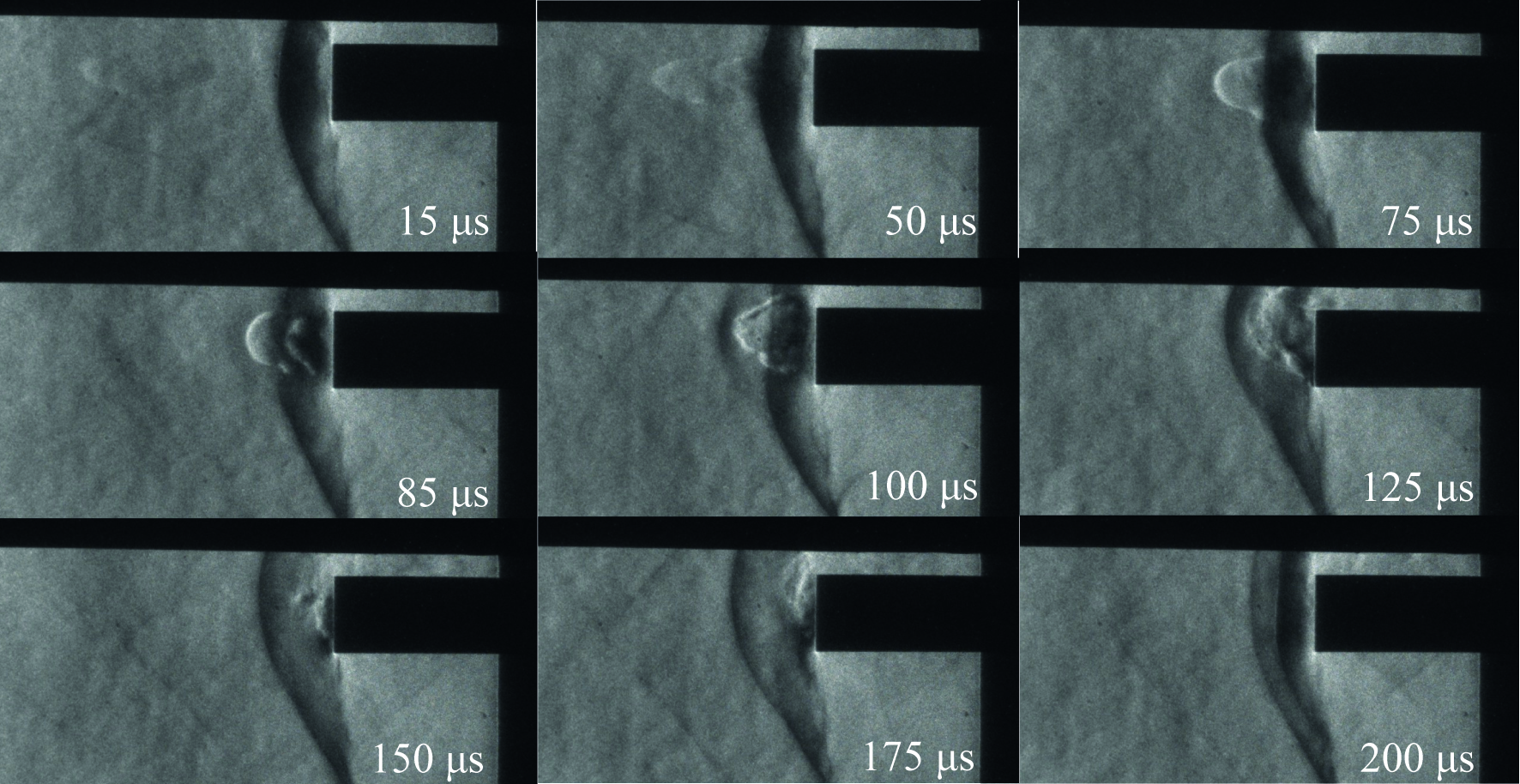
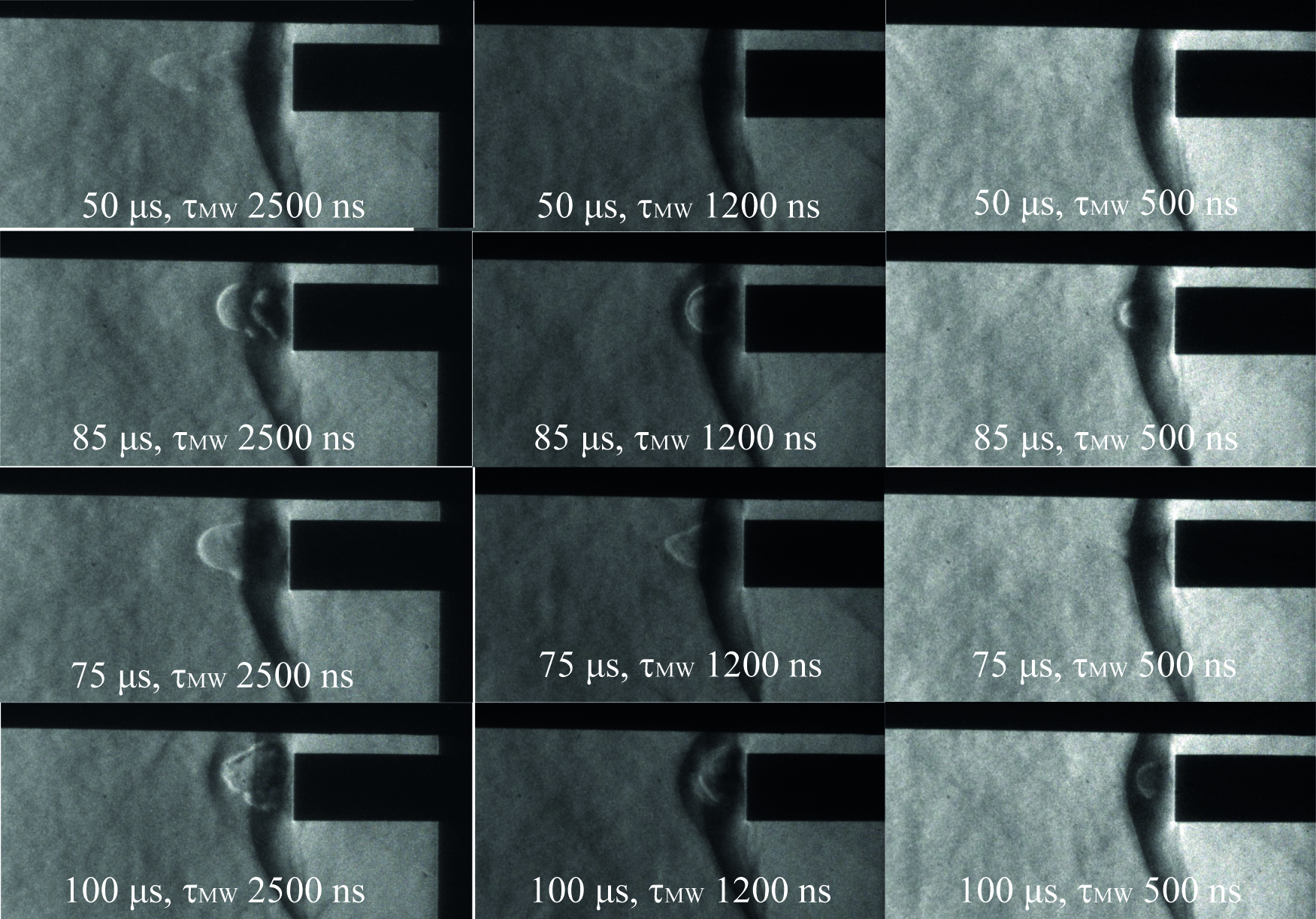
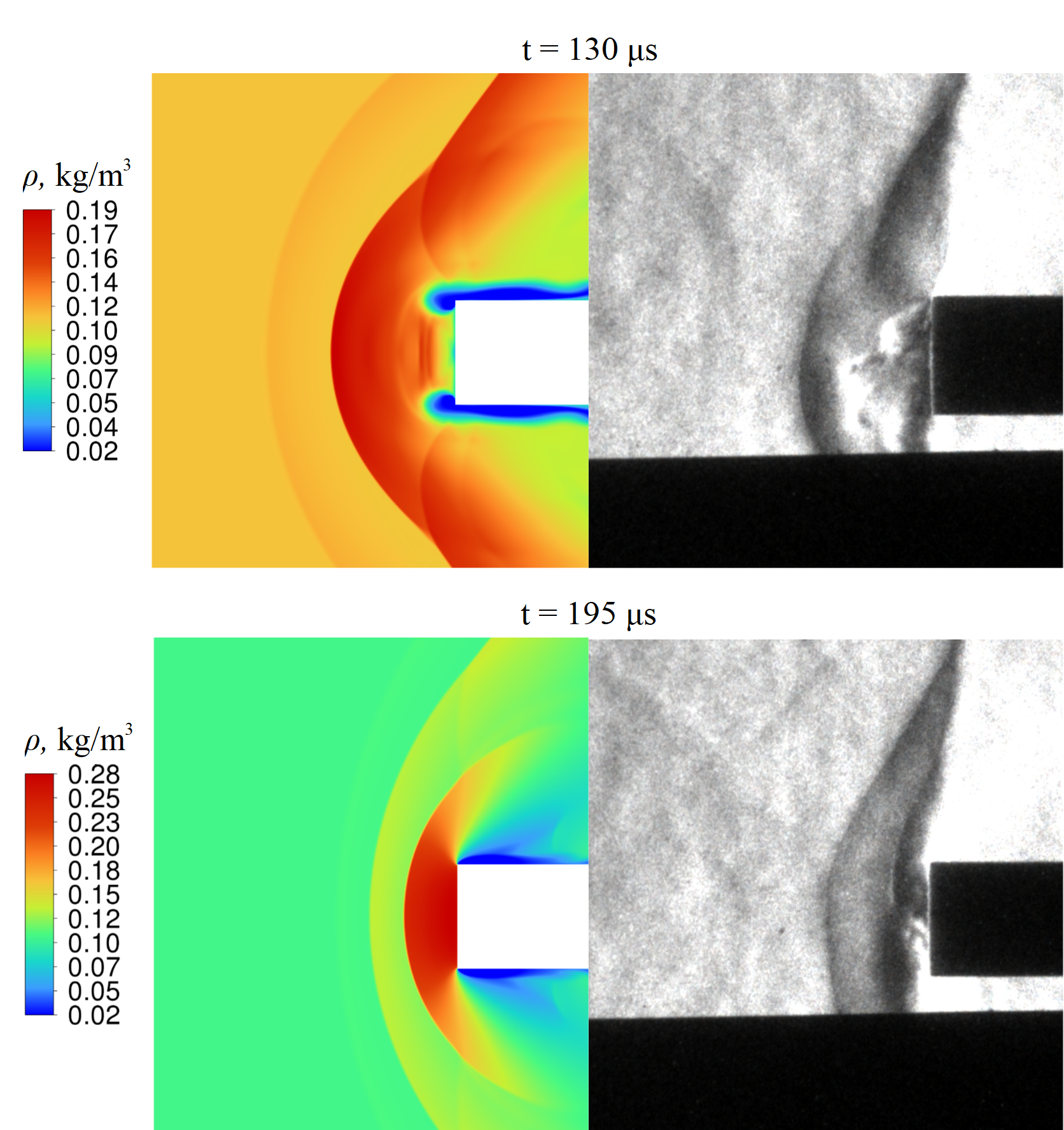
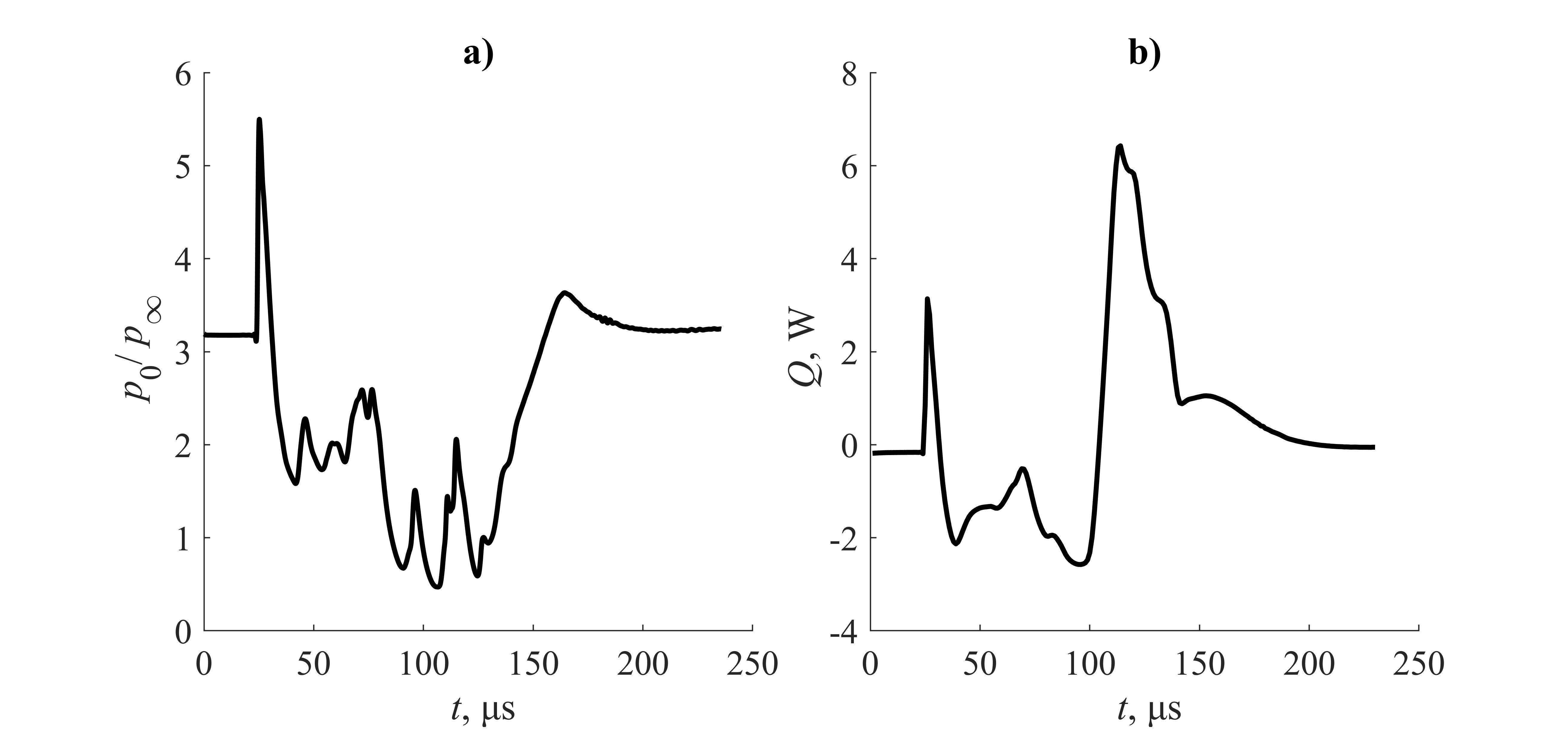
Experimental studies of microwave discharge with sparkless laser initiation were con-ducted in both quiescent and supersonic flow environments (Mach number 1.44). It was established that the active phase properties of the microwave discharge under supersonic flow conditions do not differ significantly from those observed in the absence of exter-nal flow. Shadowgraph images of shock waves in front of a cylindrical model in the su-personic flow, accompanied by energy deposition from the discharge, were obtained. Numerical simulations of gas-dynamic processes during discharge combustion, its trace evolution, and shock wave restructuring caused by the trace were performed. The results demonstrate the possibility of modifying the shock wave structure in front of the model for up to 100 μs, achieving a 30–60% reduction in stagnation pressure using a short-duration (0.5–2 μs) microwave discharge initiated by the laser.
СВЧ-разряд с безыскровой лазерной инициацией в сверхзвуковом потоке и влияние его следа на обтекание тел
Проведены экспериментальные исследования СВЧ-разряда с безыскровой лазерной инициацией в среде без внешних потоков, в условиях со сверхзвуковым потоком с числом Маха 1.44. Выяснено, что свойства активной фазы СВЧ-разряда с примененной инициацией в сверхзвуковом не отличаются значительно от случая отсутствия внешних потоков. Получены теневые фото ударных волн перед моделью-цилиндром в сверхзвуковом потоке с энерговложением рассматриваемым разрядом. Проведены численные моделирования газодинамических процессов во время горения разряда и в его следе, а также исследовано взаимодействия области нагретого газа с фронтом головной ударной волны. Показана возможность получения измененной структуры ударной волны перед моделью на 100 μs со снижением давления торможения на 30 ‒ 60% с помощью инициированного СВЧ-разряда с малой длительностью 0.5 – 2 μs.
1. Bletzinger P., Ganguly B. N., Wie D. V., Garscadden A. Plasmas in high speed aerodynamics // J. Phys. Appl. Phys. 2005. V.38, № 4. P. R33–R57. 2. Russell A., Zare-Behtash H., Kontis K. Joule heating flow control methods for high-speed flows // J. Electrost. 2016. V.80. P. 34–68. 3. Fomin V. M., Tretyakov P. K., Taran J.-P. Flow control using various plasma and aerodynamic approaches (Short review) // Aerosp. Sci. Technol. 2004. V.8, № 5. P. 411–421. 4. Starikovskiy A. Y., Aleksandrov N. L. Gasdynamic Flow Control by Ultrafast Local Heating in a Strongly Nonequilibrium Pulsed Plasma // Plasma Phys. Rep. 2021. Vol. 47, № 2. P. 148–209. 5. Knight D., Kianvashrad N. Review of Energy Deposition for High-Speed Flow Control // Ener-gies. 2022. V.15, № 24. P. 9645. 6. Azarova O. A., Kravchenko O. V. The Use of Spatially Multi-Component Plasma Structures and Combined Energy Deposition for High-Speed Flow Control: A Selective Review // Ener-gies. 2024. V.17, № 7. P. 1632. 7. Knight D. Survey of Aerodynamic Drag Reduction at High Speed by Energy Deposition // J. Propuls. Power. 2008. V.24, № 6. P. 1153–1167. 8. Azarova O. A., Erofeev A. V., Lapuskina T. A. A comparison of plasma and thermal effects upon supersonic flow past aerodynamic bodies // Technical physics letters. 2017. V.43, № 8. P. 405-408. 9. Kourtzanidis K., Raja L. L., Coumar S., Lago V. Numerical simulation of DC glow discharges for shock wave modification // 54th AIAA Aerospace Sciences Meeting. San Diego, California, USA: American Institute of Aeronautics and Astronautics, 2016. P. 1–11. 10. Azarova O. Supersonic Flow Control Using Combined Energy Deposition // Aerospace. 2015. V.2, № 1. P. 118–134. 11. Azarova O. A., Grudnitsky V. G., Kolesnichenko Y. F. Stationary streamlining bodies by su-personic flow with an infinite thin low density channel // Mat. Model. 2006. V.18, № 1. P. 79–87. 12. Anderson K., Knight D. D. Interaction of heated filaments with a blunt cylinder in supersonic flow // Shock Waves. 2011. V.21, № 2. P. 149–161. 13. Baccarella D., Lee G. S., Liu Q., Elliott G. S., Freund J. B., Lee T. Laser-Induced Plasma Igni-tion Experiments in a Direct-Connect Supersonic Combustor at Mach 3 // J. Propuls. Power. 2020. V.36, № 5. P. 732–743. 14. Brieschenk S., Kleine H., O’Byrne S. Laser ignition of hypersonic air–hydrogen flow // Shock Waves. 2013. V.23, № 5. P. 439–452. 15. Kandala R., Candler G., Glumac N., Elliott G. Simulation of Laser-Induced Plasma Experi-ments for Supersonic Flow Control // 43rd AIAA Aerospace Sciences Meeting and Exhibit. Re-no, Nevada: American Institute of Aeronautics and Astronautics, 2005. 16. O’Briant S. A., Gupta S. B., Vasu S. S. Review: laser ignition for aerospace propulsion // Pro-puls. Power Res. 2016. V.5, № 1. P. 1–21. 17. Ochs B. A., Menon S. Laser ignition in supersonic channel flow // Combust. Flame. 2020. V.214. P. 90–102. 18. Phuoc T. X. Laser-induced spark ignition fundamental and applications // Opt. Lasers Eng. 2006. V.44, № 5. P. 351–397. 19. Zvorykin V. D., Ionin A. A., Levchenko A. O., Seleznev L. V., Sinitsyn D. V., Smetanin I. V., Ustinovskii N. N., Shutov A. V. Extended plasma channels created by uv laser in air and their application to control electric discharges // Plasma Physics Reports. 2015. V.41, № 2. P. 125–162. 20. Bityurin V. A., Bocharov A. N., Dobrovolskaya A. S., Kuznetsova T. N., Popov N. A., Fili-monova E. A. Numerical Modeling of Pulse-Periodic Nanosecond Discharges // J. Phys. Conf. Ser. 2021. V.2100, № 1. P. 012032. 21. Kinefuchi K., Starikovskiy A. Y., Miles R. B. Numerical investigation of nanosecond pulsed plasma actuators for control of shock-wave/boundary-layer separation // Phys. Fluids. 2018. V.30, № 10. P. 106105. 22. Kinefuchi K., Starikovskiy A. Y., Miles R. B. Control of Shock-Wave/Boundary-Layer Interac-tion Using Nanosecond-Pulsed Plasma Actuators // J. Propuls. Power. 2018. V.34, № 4. P. 909–919. 23. Starikovskii A. Y., Nikipelov A. A., Nudnova M. M., Roupassov D. V. SDBD plasma actuator with nanosecond pulse-periodic discharge // Plasma Sources Sci. Technol. 2009. V.18, № 3. P. 034015. 24. Grachev L. P., Esakov I. I., Alexandrov K. V., Ravaev A. A., Severinov L. G. Gas discharge in quasi-optical MW beam. Moskov, 2015. 164 p. [in Russian] 25. Raizer Yu. P. Gas discharge physics. Berlin: Springer, 2009. 449 p. 26. Saifutdinov A. I., Kustova E. V. Dynamics of plasma formation and gas heating in a focused-microwave discharge in nitrogen //Journal of Applied Physics. – 2021. V. 129. №. 2. P. 023301 27. Saifutdinov A. I., Kustova E. V., Karpenko A. G., Lashkov V. A. Dynamics of Focused Pulsed Microwave Discharge in Air // Plasma Phys. Rep. 2019. Vol. 45, № 6. P. 602–609. 28. Saifutdinov A., Kustova E. Simulation of filamentation dynamics of microwave discharge in nitrogen //Plasma Sources Science and Technology. 2023. V. 32. №. 12. P. 125010. 29. Kolesnichenko Y., Brovkin V., Khmara D., Lashkov V., Mashek I., Rivkin M. Fine Structure of MW Discharge: Evolution Scenario // 41st Aerospace Sciences Meeting and Exhibit. Reno, Nevada: American Institute of Aeronautics and Astronautics, 2003. 30. Pai D. Z., Lacoste D. A., Laux C. O. Nanosecond repetitively pulsed discharges in air at atmos-pheric pressure—the spark regime // Plasma Sources Sci. Technol. 2010. V.19, № 6. P. 065015. 31. Brovkin V., Afanas’ev S., Khmara D., Kolesnichenko Y. Experimental Investigation of Com-bined Laser - DC - MW Discharges // 44th AIAA Aerospace Sciences Meeting and Exhibit. Re-no, Nevada: American Institute of Aeronautics and Astronautics, 2006. 32. Afanas’ev S. A., Brovkin V. G., Kolesnichenko Yu. F., Mashek I. Ch. Effect of gasdynamic processes on structure and threshold of laser spark initiated microwave discharge // Tech. Phys. Lett. 2011. V.37, № 8. P. 710–713. 33. Afanas’ev S.A., Brovkin V.G., Kolesnichenko Yu.F. Laser spark initiated microwave discharge // Tech. Phys. Lett. 2010. V.36, № 7. P. 672–674. 34. Khoronzhuk R. S., Karpenko A. G., Lashkov V. A., Potapenko D. P., Mashek I. Ch. Micro-wave discharge initiated by double laser spark in a supersonic airflow // J. Plasma Phys. 2015. V.81, № 3. P. 905810307. 35. Dobrov Yu. V., Lashkov V. A., Mashek I. Ch., Prokshin A. M., Renev M. E., Khoronzhuk R. S. Sparkless laser initiation of subcritical MW discharge // Journal of Engineering Physics and Thermophysics. 2024. V.97, № 4. P. 1078–1090. [in Russian] 36. Renev M. E., Dobrov Yu. V., Lashkov V. A., Osipov N. D., Mashek I. Ch., Khoronzhuk R. S. Numerical and experimental study of the temperature of the trace of laser-initiated microwave discharge // Technical physics. 2025. V.95, № 4. P. 702-711. [In Russian]. 37. Renev M. E., Dobrov Yu. V., Osipov N. D., Lashkov V. A., Mashek I. Ch., Khoronzhuk R. S. Probability, Induction Time and Size of Microwave Discharge with Laser Sparkless Initiation at Different Gas Pressure and Laser Pulse Energy // Physical-Chemical Kinetics in Gas Dynamics. 2025. V.26, № 1. P. 1-17. 38. Kolesnichenko Y., Khmara D., Afanas’ev S. Optimization of Laser-Pulse-Controlled MW En-ergy Deposition // 45th AIAA Aerospace Sciences Meeting and Exhibit. Reno, Nevada: Ameri-can Institute of Aeronautics and Astronautics, 2007. 39. Goncharenko A. M. Gaussian beams of light. Minsk: Science and technology, 1977. 144 p. [In Russian] 40. NIST Chemistry WebBook [Electronic resource]. URL: https://webbook.nist.gov/chemistry/. 41. Gupta R. N., Yos J. M., Thompson R. A., Lee K.P. A review of reaction rates and thermody-namic and transport properties for an 11-species air model for chemical and thermal nonequi-librium calculations to 30000 K, Nasa STI/Recon Technical Report L-16634 (1990). 42. Wilke C. R. A Viscosity Equation for Gas Mixtures // J. Chem. Phys. 1950. V. 18, № 4. P. 517–519. 43. Hirschfelder J. O., Curtiss C. F., Bird R. B. The molecular theory of gases and liquids. – John Wiley & Sons, 1954. 1280 p.Gnoffo P. A., Gupta R. N., Shinn J. L. Conservation Equations and Physical Models for Hypersonic Air Flows in Thermal and Chemical Nonequilibrium. NASA. TP-2867, 1989. 44. Gnoffo P. A., Gupta R. N., Shinn J. L. Conservation Equations and Physical Models for Hy-personic Air Flows in Thermal and Chemical Nonequilibrium. NASA. TP-2867, 1989.м 45. McGee H. A. Molecular Engineering. McGraw-Hill, New York. 1991. 444 p. 46. Kuo K. K. Y. Principles of Combustion. John Wiley and Sons, New York. 1986. 47. Fedorov V. Yu., Kandidov V. P. A nonlinear optical model of an air medium in the problem of filamentation of femtosecond laser pulses of different wavelengths // Optics and Spectroscopy. 2008. V.105, № 2. P. 280–287. 48. Lee L. C., Smith G. P. Photodissociation and photodetachment of molecular negative ions. VI. Ions in O 2 /CH 4 /H 2 O mixtures from 3500 to 8600 Å // J. Chem. Phys. 1979. V.70, № 4. P. 1727–1735. 49. Biagi database, www.lxcat.net, retrieved on October 28, 2021. 50. IST-Lisbon database, www.lxcat.net, retrieved on October 28, 2021. 51. Itikawa Y., Ichimura A. Cross Sections for Collisions of Electrons and Photons with Atomic Oxygen // J. Phys. Chem. Ref. Data. 1990. Vol. 19, № 3. P. 637–651. 52. TRINITI database, www.lxcat.net, retrieved on October 12, 2021. 53. Morgan database, www.lxcat.net, retrieved on October 28, 2021. 54. BSR database, www.lxcat.net, retrieved on September 29, 2022. 55. Itikawa database, www.lxcat.net, retrieved on October 28, 2021. 56. Lazarou C., Chiper A. S., Anastassiou C., Topala I., Mihaila I., Pohoata V., Georghiou G. E. Numerical simulation of the effect of water admixtures on the evolution of a helium/dry air discharge // J. Phys. Appl. Phys. 2019. V.52, № 19. P. 195203. 57. Mehr F. J., Biondi M. A. Electron Temperature Dependence of Recombination of O 2 + and N 2 + Ions with Electrons // Phys. Rev. 1969. V.181, № 1. P. 264–271. 58. Park C., Howe J. T., Jaffe R. L., Candler G. V. Review of chemical-kinetic problems of future NASA missions. II - Mars entries // J. Thermophys. Heat Transf. 1994. V.8, № 1. P. 9–23.