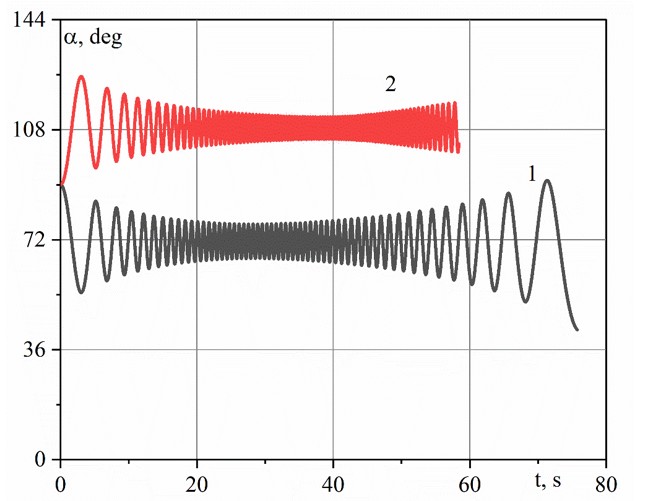
Using mathematical modeling and numerical calculations, the features of the motion of celestial bodies in the Earth's atmosphere are studied, taking into account their oscillation around the center of mass. The flight options of spherical and elliptical meteoroids are considered at different angles of entry into the Earth's atmosphere, as well as for cases when the center of mass of the ellipsoids does not coincide with their geometric center. The influence of oscillatory motion on trajectory parameters is investigated.: speed, the angle of inclination of the trajectory to the Earth's surface, high-speed pressure, etc. It has been revealed that at small angles of entry of celestial bodies into the atmosphere, very different flight modes are possible, when the configurations of meteoroids differ from the "correct" (spherical) and the positions of their centers of mass do not coincide with the centers of their shapes
Траектории метеороидов в зависимости от их конфигурации и углов входа в атмосферу Земли
С помощью методов математического моделирования и численных расчетов изу-чаются особенности движения небесных тел в атмосфере Земли при учете их коле-бания вокруг центра масс. Рассматриваются варианты полета метеороидов сфери-ческой и эллиптической формы при различных углах входа в атмосферу Земли, а также для случаев, когда центр масс эллипсоидов не совпадает с их геометрическим центром. Исследуется влияние колебательного движения на траекторные па-раметры: скорость, угол наклона траектории к земной поверхности, скоростной напор и др. Выявлено, что при небольших углах входа небесных тел в атмосферу возможны сильно различающиеся режимы их полета, когда конфигурации метеороидов отличаются от «правильной» (сферической) и положения их центров масс не совпадают с центрами их форм
1. Levin B.Y. The physical theory of meteors and meteoric matter in the solar system. Moscow: Publishing House of the USSR Academy of Sciences, 1956. 293p. (in Russ.). 2. N. G. Syzranova and V. A. Andrushchenko. Simulation of the Motion and Destruction of Bo-lides in the Earth’s Atmosphere// High Temperature. 2016. Vol. 54. No. 3, pp. 308–315. 3. Andruschenko V.A., Maksimov F.A., Syzranova N.G. Simulation of flight and destruction of the Benešov bolid // Computer Research and Modeling. 2018. Vol. 10. No. 5, pp. 605-618. DOI:10.20537/2076-7633-2018-10-5-605-618 4. Lipnitskiy Yu.M., Krasilnikov A.V., Pokrovsky A.N., Shmanenkov V.N. Unsteady gas dynam-ics. Moscow: Fizmatlit, 2003. 176p. (in Russ). 5. Yaroshevsky V.A. Motion of an uncontrolled body in the atmosphere. Moscow: Mashi-nostroenie, 1978. 168p. (in Russ.). 6. Maksimov F.A., Syzranova N.G., Andrushchenko V.A. Modeling the flight of meteoroids in the Earth's atmosphere accompanied by their oscillatory motion // Mathematical modeling and nu-merical methods. 2024. No. 4. pp. 93-110. DOI: 10.18698/2309-3684-2024-4-93110 (in Russ.). 7. Lokshin B.Y., Okunev Y.M., Samsonov V.A. Some features of the deceleration of an inhomo-geneous ball in the air // Journal of Applied Mathematics and Mechanics. 2014. Т. 78. № 1. С. 39-47. DOI: 10.1016/j.jappmathmech.2014.05.005 8. Lokshin B.YA., Okunev YU.M., Sadovnichy V.A., Samsonov V.A. On bolide flight modelling // Fundamental and applied mathematics. 2005. Vol. 11. No. 7. pp. 63-71. (in Russ.). 9. Brykina I.G., Bragin M.D. On limiting the lateral expansion of the cloud of fragments of a de-structed meteoroid // Physical-Chemical Kinetics in Gas Dynamics. 2020. V21 (1) http://chemphys.edu.ru/issues/2020-21-1/articles/894 10. Brykina I.G. Large meteoroid fragmentation: modeling the interaction of the Chelyabinsk me-teoroid with the atmosphere // Solar System Research. 2018. Т. 52. № 5. С. 426-434. DOI: 10.1134/S0038094618050027 11. Maksimov F. A. Supersonic flow of system of bodies // Computer Research and Modeling, 2013, vol. 5, no. 6, pp. 969–980 (in Russ.). 12. Guvernyuk S.V., Maksimov F. A. Supersonic flow around a flat lattice of cylindrical rods // Computational Mathematics and Mathematical Physics. 2016. Volume 56. Issue 6. PP. 1012–1019. DOI: DOI:10.1134/S0965542516060154 13. Maksimov F.A. Numerical modeling of hysteresis during flow around a flat nozzle. Mathemat-ical modeling and numerical methods // 2023. No. 4. pp. 27-46. DOI:10.18698/2309-3684-2023-4-2746 (in Russ.). 14. Lebedev A.A., Chernobrovkin L.S. Flight dynamics of unmanned aerial vehicles. Moscow: Mashinostroenie Publ., 1973. 616p. (in Russ.). 15. Euler L. Integral calculus. Volume 1. Moscow: GITTL, 1956 (in Russ.). 16. Ceplecha Z.: Earth-grazing daylight fireball of August 10, 1972 // Astron. Astrophys. 1994. V. 283. P. 287. 17. Murzinov I.V. The problem of the century: where did the Tunguska meteorite fly away // Cos-monautics and Rocket Engineering. 2015. No. 4(83). p. 65. (in Russ.). 18. Syzranova N. G., Andrushchenko V. A. Numerical Study of Nonstandard Trajectories of Ce-lestial Bodies Invading Earth’s Atmosphere. High Temperature. 2023. Vol. 61. No. 2. P.256–261. DOI:10.1134/S0018151X23020177 19. Khrennikov D. E, Titov A. K, Ershov A. E. et al. On the possibility of through passage of as-teroid bodies across the Earth’s atmosphere. Monthly Notices of the Royal Astronomical Society. 2020. vol. 493. iss. 1, pp. 1344-1351. DOI:10.1093/mnras/staa329. 20. Vasilyev N.V. The Tunguska meteorite problem today. // Planet. Space Sci. 1998. 46.129–150. 21. Antipin V.S., Yazev S.A., Kuzmin M.I. et al. Natural phenomena and substance ablative traces of the Vitim meteoroid (September 25, 2002) // Doklady Physics. 2004. Т. 49. № 10. С. 573-577. 2004. Vol. 398. №4. P.482-486. DOI: 10.1134/1.1815417 ics