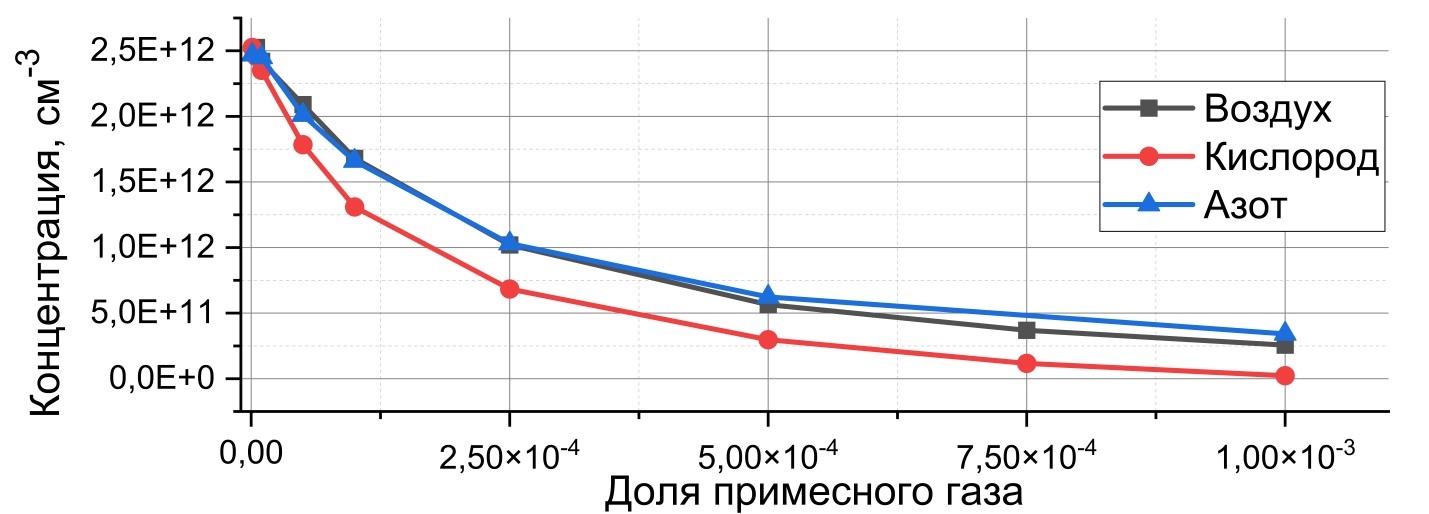
The paper presents a theoretical study of the effect of atmospheric air on argon-helium plasma of a pulsed discharge. The analysis of key reactions of interaction of nitrogen and oxygen particles with each other, with electrons and with argon and helium atoms is carried out, and the key reactions of interaction are selected. A kinetic model of Ar-He plasma is compiled and supplemented with reactions of interaction with nitrogen and oxygen atoms and molecules. Calculations of the concentration of excited argon atoms and other plasma particles are carried out. The calculation results demonstrate that when the proportion of impurity gases in the active medium of the laser exceeds 1∙10-5, their effect on the concentration of excited argon and helium atoms and ions becomes noticeable. When the proportion reaches 5∙10-4, quenching of excited atoms due to collisions with nitrogen and oxygen begins to prevail over other quenching mechanisms. The paper presents a theoretical study of the influence of atmospheric air impurity on the active medium of an optically pumped rare gas laser. The active medium of the laser is formed by passing a pulse-periodic discharge through argon-helium plasma and represents excited states of argon at the lower levels of the –s and –p multiplets. The analysis of key reactions of interaction of nitrogen and oxygen particles with each other, with electrons and with argon and helium atoms is carried out. The key reactions of interaction that have the greatest effect on the particle concentration are selected. The kinetic model of Ar-He plasma is compiled and the reactions of interaction of inert gas atoms with nitrogen and oxygen atoms, molecules and ions is added. The concentration of excited argon atoms and other plasma particles is calculated. The calculation results demonstrate that when the proportion of impurity gases in the active medium of the laser exceeds 1∙10-5, their effect on the concentration of excited argon and helium atoms and ions becomes noticeable. When the proportion reaches 5∙10-4, the quenching of excited atoms due to collisions with nitrogen and oxygen begins to prevail over other quenching mechanisms.
optically pump rare gas laser (OPRGL), inert gases, metastable atoms, kinetic model, molecular oxygen and nitrogen, quenching of excited atoms
Исследование влияния атмосферного воздуха на активную среду лазера с оптической накачкой на инертных газах
В работе представлено теоретическое исследование влияния примесного атмосферного воздуха на активную среду лазера с оптической накачкой на инертных газах. Активная среда лазера образуется при прохождении импульсно-периодического разряда через Ar-He плазму и представляет собой возбужденные состояния аргона на нижних уровнях –s и –p мультиплетов. Проведен анализ ключевых реакций взаимодействия частиц азота и кислорода друг с другом, с электронами и с атомами аргона и гелия. Выбраны ключевые реакции взаимодействия, оказывающие наибольшее влияние на концентрацию частиц. Кинетическая модель Ar-He плазмы составлена и дополнена реакциями взаимодействия атомов инертных газов с атомами, молекулами и ионами азота и кислорода. Проведены вычисления концентрации возбужденных атомов аргона и других частиц плазмы. Результаты вычислений продемонстрировали, что при доле примесных газов в активной среде лазера, превышающей 1∙10-5, их влияние на концентрацию возбужденных атомов и ионов аргона и гелия становится заметным. При достижении доли, равной 5∙10-4, тушение возбужденных атомов за счет столкновений с азотом и кислородом начинает преобладать над остальными механизмами тушения.
лазер с оптической накачкой на инертных газах (ЛОНИГ), инертные газы, метастабильные атомы, кинетическая модель, молекулярный кислород и азот, тушение возбужденных атомов
1 Han J., Heaven M.C. Gain and lasing of optically pumped metastable rare gas atoms // Optics Letters. – 2012. - Vol. 37, No. 11, pp 2157-2159 DOI:10.1364/OL.37.002157 2 Emmons D.J., Weeks D.E. Kinetics of high pressure argon-helium pulsed gas discharge// Journal of Applied Physics. – 2017. – Vol. 121, No. 20. DOI: 10.1063/1.4983678 3 Han J., Glebov L., Venus G., Heaven M.C. Demonstration of diode-pumped metastable Ar laser // Optics Letters. – 2013. - Vol. 38, No. 24, pp 5458-5461. DOI: 10.1364/OL.38.005458. 4 Emmons D.J., Weeks D.E., Eshel B. and Perram G.P., Metastable Ar(1s5) density dependence on pressure and argon-helium mixture in a high pressure radio frequency dielectric barrier discharge // Journal of Applied Physics, 2018, vol. 123, no 4. DOI:10.1063/1.5009337 5 Mikheyev P.A., Chernyshov A.K., Svistun M.I., Ufimtsev N.I., Kartamysheva O.S., Heaven M.C., and Azyazov V.N., Transversely optically pumped Ar:He laser with a pulsed-periodic discharge// Opt Express, 2019, vol. 27. DOI:10.1364/OE.383276 6 Rawlins W.T., Hoskinson A.R., Galbally-Kinney K.L., Davis S.J., Hopwood J.A., Han J., and Heaven M.C., Kinetics of Metastable Argon Optical Excitation and Gain in Ar/He Microplasmas // J Phys Chem, 2023, vol. 123, no. 11. DOI:10.1021/acs.jpca.3c00048 7 Zhang Z., Lei P., Song Z., Sun P., Zuo D., Wang X. Optically pumped argon metastable laser with repetitively pulsed discharge in a closed chamber // Journal of Applied Physics, 2021, vol. 129, no. 14. DOI:10.1063/5.0041297 8 Lei P., Chen Z., Shen Y., Wang X., Zuo D., Demonstration of a metastable argon laser of 10 W by transverse pumping // Opt. Lett., 2024, vol. 49. DOI:10.1364/OL.533007 9 Sanderson C.R., Ballmann C.W., Han J., Clark A.B., Hokr B.H., Xu K.G. and Heaven M.C., Demonstration of a quasi-CW diode-pumped metastable xenon laser // Opt Express, 2019, vol. 27. DOI:10.1364/OE.27.036011 10 Mikheyev P.A., Han J., Clark A., Sanderson C., and Heaven M.C., Production of Ar and Xe metastables in rare gas mixtures in a dielectric barrier discharge // Journal of Physics D: Applied Physics, 2017, vol. 50, no. 48 DOI:10.1088/1361-6463/aa91bf 11 Demyanov A.V., Kochetov I.V., Mikheyev P.A., Azyazov V.N., and Heaven M.C., Kinetic analysis of rare gas metastable production and optically pumped Xe lasers // Journal of Physics D: Applied Physics, 2018, vol. 51, no. 4. DOI: 10.1088/1361-6463/aa9e40 12 Juriev A.V., Adamenkov Yu.A., Gorbunov M.A. et al., Simultaneous Generation at Three Wavelengths in an Optically Pumped He–Kr–Ar Medium // Bulletin of the Lebedev Physics Institute, 2024, vol. 51. DOI: 10.3103/S1068335624601493 13 Juriev A.V., Adamenkov Yu.A., Gorbunov M.A. et al., Generation of radiation at a wavelength of 893 nm on metastable krypton atoms using optical pumping // Achievements of applied physics, 2024, vol. 12. No. 6. Pp. 556-566 [in Russian] DOI:10.51368/2307-4469-2024-12-6-556-566 14 Adamenkov A.A., Adamenkov Yu.A., Volkov M.A., Vyskubenko B.A., Garanin S.G., Gorbunov M.A., Domazhirov A.P., Egorushin M.V., Kalacheva A.A., Kolobyanin Yu.V., Konkina N.A., Starikov F.A., Khlebnikov A.A., Shaidulina V.A., Laser on metastable Ar* atoms with transverse optical pumping with a power of 1 W // Quantum Electronics, 2022, vol. 52, no. 8, pp. 695-697 [in Russian] 15 Juriev A.V., Adamenkov Y.A., Gorbunov M.A. et al. Kinetic Processes of Argon–Helium Plasma of a Pulsed Discharge. Fluid Dyn., 2025, vol. 60, no. DOI: 10.1134/S0015462825600956 16 Zhu X. and Pu Y. A simple collisional–radiative model for low-temperature argon discharges with pressure ranging from 1Pa to atmospheric pressure: kinetics of Paschen 1s and 2p levels // J. Phys. D: Appl. Phys., 2010, vol. 43. DOI: 10.1088/0022-3727/43/1/015204 17 Dytko N.A., Ionikh Y.Z., Kochetov I.V., Experimental and theoretical study of the transition between diffuse and contracted forms of the glow discharge in argon, Journal of Physics D: Applied Physics, 2008, vol. 41, no. 5. DOI: 10.1088/0022-3727/41/5/055204 18 Emmons D.J. and Weeks D.E. Kinetics of high pressure argon-helium pulsed gas discharge // Journal of applied physics, 2017, vol. 121. DOI: 10.1063/1.4983678 19 Stankov M., Becker M.M., Hoder T. and Lohagen D. Extended reaction kinetics model for non-thermal argon plasmas and its test against experimental data // Plasma Sources Science and Technology, 2022, vol. 31. DOI: 10.1088/1361-6595/ac9332 20 Shiu S., Biondi M.¬ Dissociative recombination in argon: Dependence of the total rate coefficient and excited-state production on electron temperature // Physical review A, 1977, vol. 17, no. 3. DOI: 10.1103/PhysRevA.17.868 21 Zagidullin M.V., Mikheyev P.A. Numerical study of a nanosecond repetitively pulsed discharge in an Ar-He mixture at near atmospheric pressure // Physics of Plasmas, 2023, vol. 30. DOI: 10.1063/5.0170170 22 Shon J.W., Kushner M.J. Excitation mechanisms and gain modeling of the highpressure atomic Ar laser in He/Ar mitures // Journal of applied physics, 1994, vol. 75. DOI: 10.1063/1.356334 23 Jones J.D., Listert D.G., Wareing D.P. The temperature dependence of the three-body reaction rate coefficient for some rare-gas atomic ion-atom reaction rate coefficient for some atomic ion-atom reactions in the range 100-300K // Department of Physics, 1979, vol. 29. 24 Karelin A.V., Simakova O.V. Kinetics of the active medium of a multiwave He-Ar-Xe laser pumped by a hard ionizer // International Conference on Atomic and Molecular Pulsed Lasers, 2000, Proceedings Volume 4071. 25 Karelin A.V., Simakova O.V. Kinetics of the active medium of a multiwave He-Ar-Xe laser pumped by a hard ioniser // Quantum Electron, 1999, vol. 29. DOI: 10.1070/QE1999v029n08ABEH001552 26 Hoskinson A.R., Gregorio J., Hopwood J., Argon metastable production in argon-helium microplasmas, Journal of Applied Physics, 2016, vol. 119, no. 23. DOI: 10.1063/1.4954077 27 Kannari F., Obara M., Fujioka T. An advanced kinetic model of electronbeamexcited KrF lasers including the vibrational relaxation in KrF(B) and collisional mixing of KrF(B,C) //J. Appl. Phys., 1985, vol. 57. DOI: 10.1063/1.334590 28 Kuntner N. - Modeling and Simulation of Electronic Excitation in Oxygen-Helium Discharges and Plasma-assisted Combustion // Institute of Combustion Technology for Aerospace Engineering University of Stuttgart, 2017. 29 Lazarou C., Anastassiou C. - Numerical simulation of a capillary helium and helium-oxygen atmospheric pressure plasma jet: propagation dynamics and interaction with dielectric // Plasma Sources Science and Technology, 2018, vol. 27. DOI:10.1088/1361-6595/aadeb8 30 Baeva M., Stankov M., Trautvetter T., Methling R. - The effect of oxygen admixture on the properties of microwave generated plasma in Ar–O2: a modelling study // J. Phys. D: Appl. Phys., 2021, vol. 54. DOI: 10.1088/1361-6463/ac08cc 31 Park G., Lee H., Kim G., Lee J. K. - Global Model of He/O2 and Ar/O2 Atmospheric Pressure Glow Discharges // Plasma Processes and Polymers, 2008, vol. 5. DOI: 10.1002/ppap.200800019 32 Gudmundsson J.T., Kouznetsov I.G., Patel K.K., Lieberman M.A. - Electronegativity of low-pressure high-density oxygen discharges //Journal of Physics, 2001, vol. 34. DOI: 10.1088/0022-3727/34/7/312 33 A.N. Ivanov - Physicochemical processes in oxygen-argon plasma. Thesis, 2003, Ivanovo. [in Russian] 34 Debal F., Bretagne J. - Analysis of DC magnetron discharges in Ar-N2 gas mixtures. Comparison of a collisionalradiative model with optical emission spectroscopy // Plasma Sources Sci. Technol., 1998, vol. 7. DOI: 10.1088/0963-0252/7/2/016 35 Bourdon A., Darny T. - Numerical and experimental study of the dynamics of a helium plasma gun discharge with various amounts of N2 admixture // Plasma Sources Sci. Technol., 2016, vol. 25. DOI: 10.1088/0963-0252/25/3/035002 36 Zhang Y., Shneider M.N. - Femtosecond Laser Excitation in Argon–Nitrogen Mixtures // AIAA JOURNAL, 2018 DOI: 10.2514/1.J056084 37 Kang N., Gaboriau F. - Modeling and experimental study of molecular nitrogen dissociation in an Ar–N2 ICP discharge // Plasma Sources Sci. Technol., 2011, vol. 20. DOI: 10.1088/0963-0252/20/4/045015 38 Kutasi K., Guerra V. and Sa P. - Theoretical insight into Ar–O2 surface-wave microwave discharges // J. Phys. D: Appl. Phys., 2010, vol. 43. DOI: 10.1088/0022-3727/43/17/175201 39 Rahman M.Z., Mynuddin M. - Kinetic Modelling of Atmospheric Pressure Nitrogen Plasma // American Journal of Modern Physics, 2018, vol. 7, no. 5. DOI: 10.11648/j.ajmp.20180705.13