Possibilities of simplified numerical modeling of the Stardust sample return capsule flight
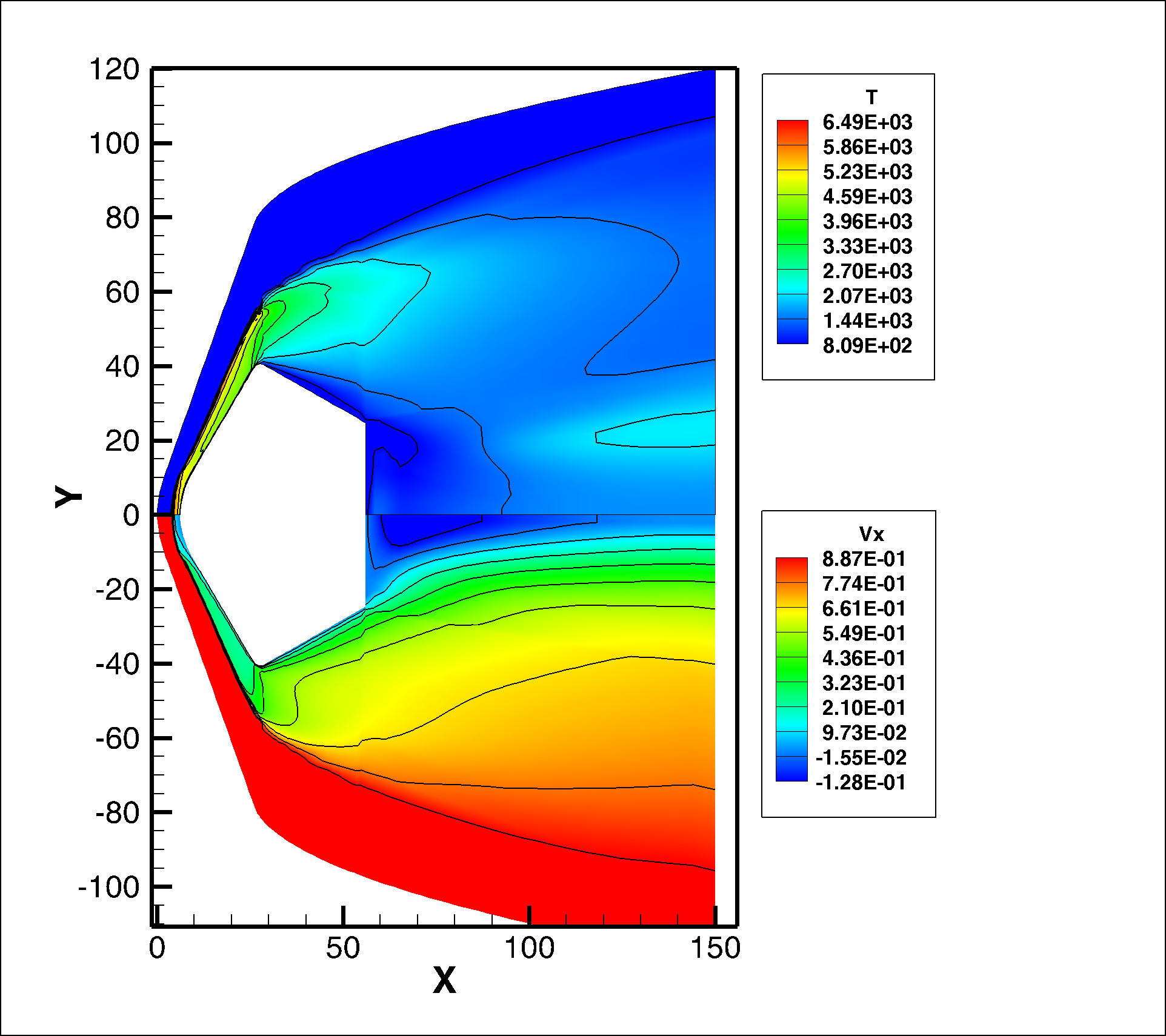
The article examines the flight of the Stardust return capsule. A study was conducted to explore the possibility of a simplified calculation of the capsule flow using the perfect gas model by varying the specific heat ratio in the NERAT-2D. Over a certain altitude range, this assumption allows for a quick and accurate flow pattern, but often underestimates the capsule surface heat flux.
high-speed flow, re-entry capsule, surface heat flux, perfect gas model
В данной статье рассматривается полёт спускаемой капсулы космического аппарата Stardust. Проведено исследование возможности упрощённого расчёта обтекания капсулы по модели совершенного газа путём варьирования показателя адиабаты в программном комплексе NERAT-2D. В определённом диапазоне высот это допущение позволяет быстро получить корректную картину обтекания, но зачастую занижает тепловой поток, поступающий на поверхность аппарата.
высокоскоростное обтекание, спускаемый аппарат, поверхностный тепловой поток, модель совершенного газа
1. Olynick D. R., Chen Y.-K., Tauber M. E. Aerothermodynamics of the Stardust Sample Return Capsule. J. of Spacecraft and Rockets, Vol. 36, No. 3, May-June 1999, pp. 442-462. 2. J. Lachaud, T. Cozmuta Multiscale Approach to Ablation Modeling of PICA 3. F. Milos, Y. Chen Ablation Predictions for Carbonaceous Materials Using CEA- and JANNAF-Based Specied Thermodynamics 4. Chen Y.-K., Milos F. S. Finite-Rate Ablation Boundary Conditions for Carbon-Phenolic Heat-Shield. NASA Ames Research Center, Moffett Field, CA 94035-1000. 5. Milos F. S., Chen Y.-K. Ablation Predictions for Carbonaceous Materials Using Two Databases for Species Thermodynamics. J. of Spacecraft and Rockets, Vol. 50, No. 2, March–April 2013. DOI: 10.2514/1.42681 6. Chen Y.-K., Milos F. S. Ablation and Thermal Response Program for Spacecraft Heatshield Analysis. J. of Spacecraft and Rockets, Vol. 36, No. 3, May–June 1999. DOI: 10.2514/2.3469 7. P. Jenniskens, M. A. Wilson, M. Winter et al. Resolved CN Band Profile of Stardust Capsule Radiation at Peak Heating. J. of Spacecraft and Rockets, Vol. 47, No. 6, November–December 2010. DOI: 10.2514/1.38074 8. C. Park. Calculation of Stagnation-Point Heating Rates Assotiated with Stardust Vehicle. J. of Spacecraft and Rockets, Vol. 44, No. 1, January–February 2007. DOI: 10.2514/1.15745 9. Boyd I.D., Trumble K.A., Wright M.J. 2010 Modeling of Stardust entry at high altitude, Part 1: Flowfield analysis // J. Spacecraft and Rockets. Vol.47. No. 5. P.708-717. 10. Liu Y., Prabhu D., Trumble K.A. et al. Radiation modeling for the reentry of the Stardust sample return capsule // J. Spacecraft and Rockets. Vol.47. No.5. 2010. P.741-752. 11. Mitcheltree R.A., Wilmoth R.G., Cheatwood G.J., Brauckmann, and Green F.A. Aerodynamics of Stardust Sample Return Capsule// J. Spacecraft and Rockets. Vol.36. No.3. 1999. P.429-435. 12. Shang J.S., Surzhikov S.T. 2011 Simulating Stardust Earth Reentry with Radiation Heat Transfer// J. of Spacecraft and Rockets. Vol.48. No.3. pp.385-396. 13. Surzhikov S., Shang J. 2014 eRC Model for Prediction of Molecular Bands Radiation for Stardust Entry Conditions//AIAA 2014-2490. 42 p. 14. Trumble K.A., Cozmuta I., Sepka S. et al. 2010 Postflight aerothermal analysis of Stardust sample return capsule // J. Spacecraft and Rockets. Vol.47. No.5. P.765-774. 15. Суржиков С. Т. Компьютерная аэрофизика спускаемых космических аппаратов. Двухмерные модели. — М.: ФИЗМАТЛИТ, 2018. — 544 с. 16. Суржиков С. Т. Радиационный нагрев поверхности сверхорбитальных спускаемых космических аппаратов с учетом атомных линий//Физико-химическая кинетика в газовой динамике. 2014. Т.15, вып. 4. http://chemphys.edu.ru/issues/2014-15-4/articles/235/ 17. Батыгина В. К. Исследование процесса разрушения фенола при высоких тепловых нагрузках//Физико-химическая кинетика в газовой динамике. 2024. Т.25, вып. 7. http://chemphys.edu.ru/issues/2024-25-7/articles/1139/