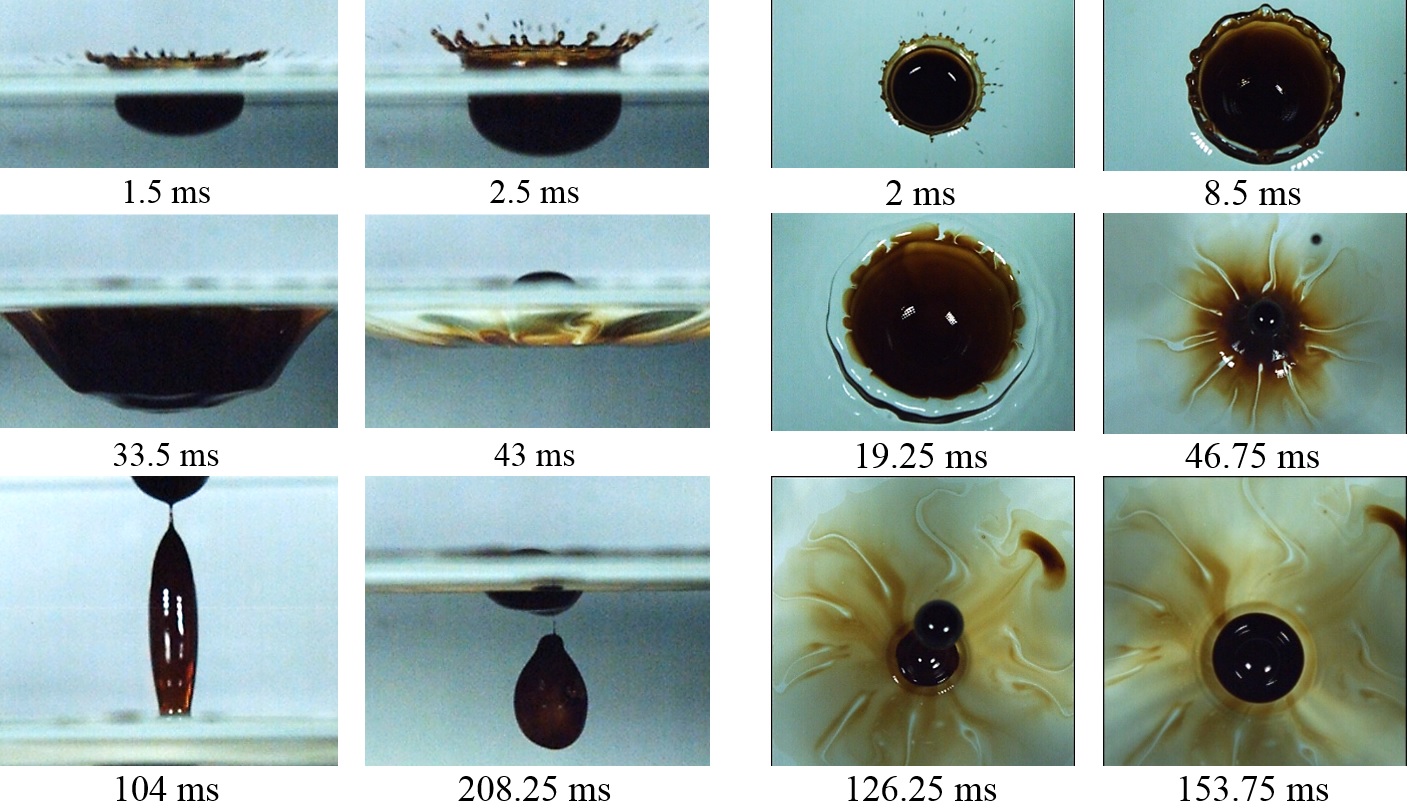
Evolution of the spreading pattern of a freely falling petroleum drop in water in the impact flow regime
High-speed video recording was used to trace in detail the initial stage of the flow pattern evolution dur-ing the spreading of a freely falling oil drop in a cuvette containing tap water. The experiments were con-ducted in impact mode, when the drop's kinetic energy (DKE) exceeds its surface potential energy (SPE). At the initial stage of spreading, the drop, deforming the free surface, forms an energy-laden layer in the contact area, comprising both contacting fluids. The boundary of the contact area disintegrates into individual trickles of water containing petroleum drops. Fine sprays emerge from the tips of the trickles. The sprays emission process occurs cyclically, with each new group of droplets emerging at an increasingly greater angle to the horizon. Over time, the droplet diameters increase, and their velocity decreases. Examination of the enlarged images reveals that the droplets forming the "oil mist" contain both oil and water. The inflowing oil spreads across the cavity surface and collects in a splash, from the apex of which a new drop containing both oil and water is ejected. The bridge connecting the droplet to the remainder of the splash contains small oil droplets encased in water. The sinking splash and the returning droplet form new cavities of rapidly changing shape. During the intermediate stage of evolution, an oil drop sepa-rates from the cavity bottom, gradually coming to a stop, and then resurfaces. The boundary of the oil film spreading over the fluid surface is broken by thin fractures into separate sectors. The positions of the fracture lines are determined by depressions at the boundary of the oil-water spreading region on the sur-face of the crown. The changes in the dimensions of the cavity and crown are traced during the initial stage of the flow pattern evolution.
Методами высокоскоростной видеорегистрации детально прослежен начальный этап эволюции картины течения при растекании свободно падающей капли нефти в кювете с водопроводной водой. Опыты выполнены в импактном режиме, когда кинетическая энергия капли (КЭК) превосходит ее потенциальную поверхностную энергию (ППЭ). На начальном этапе слияния капля, деформирующая свободную поверхность, образует в области контакта сред энергетически нагруженный слой, включающий обе контактирующие жидкости. Граница области контакта сред распадается на отдельные струйки воды с капельками нефти. С вершин струек вылетают мелкие брызги. Процесс вылета брызг идет циклически, каждая новая группа вылетает под все большим углом к горизонту. Со временем диаметры капелек растут, скорости их движения уменьшаются. Рассмотрение увеличен-ных изображений показывает, что капельки, формирующие «нефтяной туман», содержат и нефть, и воду. Втекающая нефть распределяется по поверхности каверны и собирается во всплеске, с вершины которого выбрасывается новая капля, содержащая и нефть, и воду. Перемычка, связывающая каплю с остатком всплеска, включает мелкие капельки нефти в водяной струйке. Погружающийся всплеск и возвращающаяся капля образуют новые каверны быстро меняющейся формы. На промежуточной стадии эволюции от дна каверны отделяется нефтяная капля, которая постепенно останавливается и всплывает. Граница растекающейся по поверхности жидкости нефтяной пленки разрывается тонкими трещинами на отдельные сектора. Положение линий разрыва определяют впади-ны на границе области растекания нефти с водой на поверхности венца. Прослежено изменение размеров каверны и венца на начальном этапе эволюции картины течения.
1. Крупнейшие разливы нефти в истории. Site: https://nangs.org/news/world/11-krupneyshih-razlivov-nefti-v-istorii 2. Thomson J.J., Newall H.F. On the formation of vortex rings by drops falling into liquids, and some allied phenomena // Proc. R. Soc. Lond. 1885. V. 29. pp. 417–436. 3. Murphy D.W., Li C., d’Albignac V., Morra D., Katz J. Splash behaviour and oily marine aerosol pro-duction by raindrops impacting oil slicks // J. Fluid Mech. 2015. V. 780. pp. 536 – 577. 4. Luswetia E., Kandab E.K., Obandoa J., Makokhaa M. Effects of oil exploration on surface water quality– a review // Water Practice & Technology. 2022. V. 17(10). p. 2171. doi: 10.2166/wpt.2022.104 5. Chen R. H., Lai C.-M. Collision outcome of a water drop on the surface of a deep diesel fuel pool // Proc. Ins. Mech. Engs., Part C: J. Mech. Engng. Sci. 2011. V. 225(7). pp. 1–11. DOI: 10.1177/0954406211403066 6. Fujimatsu T., Fujita H., Hirota M., Okada O. Interfacial deformation between an impacting water drop and a silicone-oil surface // J. Colloid and Interface Science. 2003. V. 264. pp. 212–220. doi:10.1016/S0021-9797(03)00402-8 7. Che Z., Matar O.K. Impact of droplets on immiscible liquid films // Soft Matter. 2018. V. 14(9). pp. 1540–1551. doi: 10.1039/c7sm02089a 8. Kim D., Lee J., Bose A., Kim I., Lee J. The impact of an oil droplet on an oil layer on water // J. Flu-id Mech. 2021. V. 906. A5. DOI: 10.1017/jfm.2020.791 9. Lhuissier H., SunC., Prosperetti A., Lohse D. Drop fragmentation at impact onto a bath of an im-miscible liquid // Phys. Rev. Lett. 2013. V. 110. pp. 264503. DOI:10.1103/PhysRevLett.110.264503 10. Li E. Q., Thoraval M.-J., Marston J. O., Thoroddsen S. T., Early azimuthal instability during drop impact // J. Fluid Mech. 2018. V. 848. pp. 821–835. DOI: 10.1017/jfm.2018.383 11. Чашечкин Ю. Д., Ильиных А. Ю. Распад капли на отдельные волокна на границе области кон-такта с принимающей жидкостью // Доклады РАН. Физика. 2021. Т. 497. № 1. C. 31–35. DOI: 10.31857/S2686740021020139 12. Manzello S.L., Yang J.C., Cleary T.G. On the interaction of a liquid droplet with a pool of hot cook-ing oil // Fire Safety J. 2003. V.38. pp. 651–659. doi:10.1016/S0379-7112(03)00048-1 13. Xu M., Zhang J., Wu C. et al. Collision dynamics of a single water droplet impinging on a high-temperature pool of oil // Acta Mech. 2018. V. 229. pp. 1567–1577. https://doi.org/10.1007/s00707-017-2071-5 14. Lan M.J., Wang X.S., Zhu P., Chen P.P. Experimental study on the dynamic process of a water drop with additives impact upon hot liquid fuel surfaces // Energy Proc. 2015. V. 66. pp. 173–176. 15. Ильиных А.Ю., Чашечкин Ю.Д. Гидродинамика погружающейся капли: несмешивающиеся жидкости // Изв. РАН. МЖГ. 2020. Т. 55. № 2. С. 169–176. 16. Чашечкин Ю.Д., Ильиных А.Ю. Растекание капли воды в слое масла // Доклады РАН. Физика. 2020. Т. 490. С. 87–94. DOI10.1134/S1028335820020020. 17. Чашечкин Ю.Д., Ильиных А.Ю. Погружение свободно падающей капли и последующий всплеск: тонкие структуры течений // ПЭОС. 2016. Т. 19. Вып. 2. С. 2 – 30. 18. Чашечкин Ю.Д., Ильиных А.Ю., Хайирбеков Ш. Начальный этап слияния составной капли в импактном режиме // Изв. РАН. МЖГ. 2024. № 2. С. 35–51. DOI: 10.31857/S1024708424020045 19. Chies M., Melheim J.A., Pedersen A., Ingebrigtsen S., Berg G. Forces acting on water droplets fall-ing in oil under the influence of an electric field: numerical predictions versus experimental observa-tions // Europ. J. Mechanics - B/Fluids. 2005. V. 24(6). pp. 717–732. https://doi.org/10.1016/j.euromechflu.2005.03.005. 20. Чашечкин Ю. Д., Ильиных А. Ю. Влияние растворимости на структуру дна каверны при слия-нии капли в импактном режиме // Физико-химическая кинетика в газовой динамике. 2025. Т. 26(2). C. 1–16. http://chemphys.edu.ru/issues/2025-26-2/articles/1175 21. Ландау Л.Д., Лифшиц Е.М. Гидродинамика. М.: Наука, 1986. 22. Feistel R. Thermodynamic properties of seawater, ice and humid air: TEOS-10, before and beyond // Ocean Sciences. 2018. V.14. pp. 471–502. 23. Harvey A.H., Hrubý J., Meier K. Improved and always improving: reference formulations for ther-mophysical properties of water // J. of Phys. and Chem. Ref. Data. 2023. V.52. p. 011501. doi: 10.1063/5.0125524 24. Eisenberg D., Kauzmann W. The Structure and Properties of Water (Oxford Classic Texts in the Physical Sciences). Oxford: Oxford University Press, 2005. 25. Teschke O., de Souza E.F. Water molecule clusters measured at water/air interfaces using atomic force microscopy // Phys. Chem. Chem. Phys. 2005. V.7(22). pp. 3856–3865. DOI: https://doi.org/10.1039/B511257E 26. Bunkin N.F., Suyazov N.V., Shkirin A.V., Ignat’ev P.S., Indukaev K.V. Study of Nanostructure of highly purified water by measuring scattering matrix elements of laser radiation // Phys. Wave Phe-nom. 2008. V.16. pp. 243–260. DOI:10.3103/S1541308X08040018 27. Malenkov G.G. Structure and dynamics of surfaces of thin films and water microdroplets // Colloid Journal. 2010. V.72(5). pp. 649–659. DOI: 10.1134/S1061933X1005011X 28. Фотографии фотосферы Солнца. Сайт: https://xras.ru/sun_pictures.html. 29. Chashechkin Yu.D. Foundations of engineering mathematics applied for fluid flows // Axioms. 2021. V.10. p. 286. https://doi.org/10.3390/axioms10040286 30. Chashechkin Y.D., Ochirov A.A. Periodic flows in a viscous stratified fluid in a homogeneous gravi-tational field // Mathematics. 2023. V.11. p. 4443. https://doi.org/10.3390/math11214443 31. Чашечкин Ю.Д. Закономерности распределения вещества свободно падающей окрашенной кап-ли в прозрачной принимающей жидкости (обзор) // Изв. РАН. МЖГ. 2025. №1. C. 34–76. DOI: 10.1134/S0015462824604315 32. УИУ “ГФК ИПМех РАН”: Гидрофизический комплекс для моделирования гидродинамических процессов в окружающей среде и их воздействия на подводные технические объекты, а также распространения примесей в океане и атмосфере. Сайт: http://www.ipmnet.ru/uniqequip/gfk/#equip. 33. Чашечкин Ю.Д., Ильиных А.Ю. Разрыв спадающего всплеска – динамического следа слияния свободно падающей капли с покоящейся принимающей жидкостью // Доклады РАН. Физика. 2022. Т. 505. С. 50–58. 34. Чашечкин Ю.Д., Прохоров В.Е. Трансформации перемычки в процессе отрыва капли // ПМТФ. 2016. № 3. С. 16–31. DOI: 10.15372/PMTF20160303 35. Чашечкин Ю.Д., Ильиных А.Ю. Множественные выбросы брызг при ударе капли // Доклады РАН. 2020. Т. 494. C. 42–46. DOI: 10.31857/S2686740020050181.