Cylindrical cellular detonation in a hydrogen-air mixture with ozone and argon additives


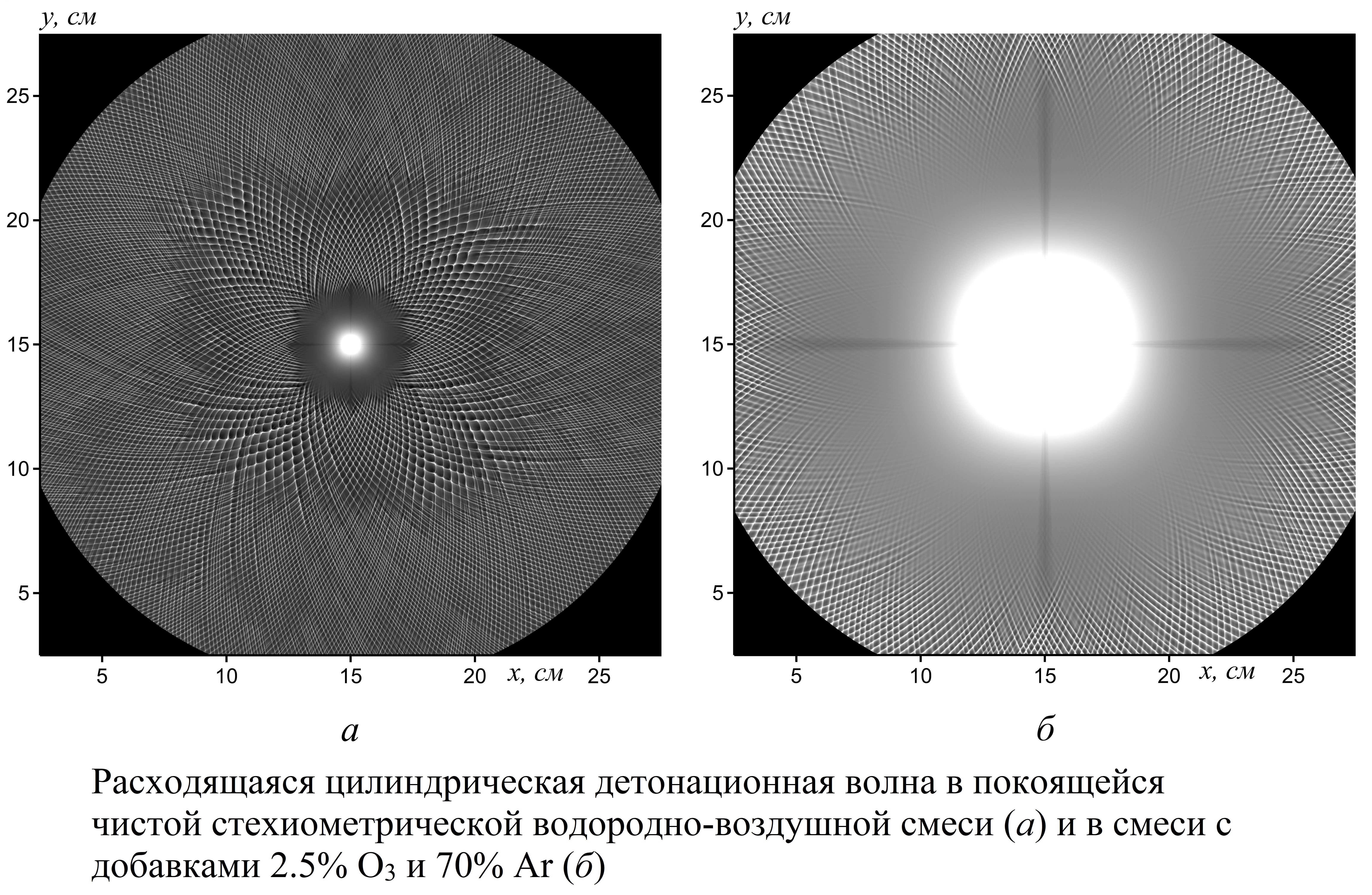
Using a detailed kinetic mechanism of chemical interaction, the effect of ozone and argon additives to a stoichiometric hydrogen-air mixture on the parameters of a diverging cylindrical detonation wave was studied with the aim of detonation combustion control. It was found that the molar fractions of these additives can be selected so that the transverse size of the cell of cylindrical detonation in the resulting mixture remains close to the average transverse size of the detonation cell in a pure mixture, while the temperature of the detonation products is significantly reduced. Influence of the gas mixture rotation on the propagation of a cylindrical wave was investigated. It was established that ozone and argon additives at the selected concentrations increase the stability of a divergent cylindrical detonation to disturbances caused by the rotation of the combustible mixture.

divergent cylindrical detonation, hydrogen-air mixture, ozone, argon, rotating combustible mixture

Цилиндрическая ячеистая детонация в водородно-воздушной смеси с добавками озона и аргона

Используя детальный кинетический механизм химического взаимодействия, численно исследовано влияние добавок озона и аргона в стехиометрическую водородно-воздушную смесь на параметры расходящейся цилиндрической волны детонации с целью управления детонационным горением. Установлено, что мольные доли вносимых добавок могут быть подобраны так, что поперечный размер ячейки цилиндрической детонации в полученной смеси будет близок к среднему поперечному размеру детонационной ячейки в чистой смеси, при этом температура продуктов детонации будет существенно снижена. Рассмотрено влияние вращения смеси на распространение цилиндрической волны. Обнаружено, что внесение добавок озона и аргона в подобранных концентрациях повышает устойчивость расходящейся цилиндрической детонации к возмущениям, вызванным вращением горючей смеси.
расходящаяся цилиндрическая детонация, водородно-воздушная смесь, озон, аргон, вращающаяся горючая смесь


1. Vasil’ev A.A., Pinaev A.V., Trubitsyn A.A., Grachev A.Yu., Trotsyuk A.V., Fomin P.A., Trilis A.V. Combust. Explos. Shock Waves, 2017, vol. 53, pp. 8–14. https://doi.org/10.1134/S0010508217010026
2. Levin V.A., Zhuravskaya T.A. Technical Physics Letters, 2017, vol. 43, no. 3, pp. 316–319. https://doi.org/10.1134/S1063785017030191
3. Levin V.A., Zhuravskaya T.A. Proceedings of the Steklov Institute of Mathematics, 2018, vol. 300, pp. 114–125. https://doi.org/10.1134/S0081543818010091
4. Levin V.A., Zhuravskaya T.A. Combustion Science and Technology, 2023, vol. 195, no. 7, pp. 1–13. https://doi.org/10.1080/00102202.2018.1557641
5. Levin V.A., Zhuravskaya T.A. Tech. Phys. Lett., 2020, vol. 46, no. 2, pp. 189–192. https://doi.org/10.1134/S1063785020020248
6. Zhuravskaya T.A., Levin V.A. Fluid Dyn., 2020, vol. 55, pp. 488–497. https://doi.org/10.1134/S0015462820040138
7. Cherif M.A., Shcherbanev S.A., Starikovskaia S.M., Vidal P. Combustion and Flame, 2020, vol. 217, pp. 1–3. https://doi.org/10.1016/j.combustflame.2020.03.014
8. Crane J., Shi X., Singh A.V., Tao Y., Wang H. Combustion and Flame, 2019, vol. 200, pp. 44–52. https://doi.org/10.1016/j.combustflame.2018.11.008
9. Levin V.A., Zhuravskaya T.A. Combustion and Plasma Chemistry, 2022, vol. 20, no. 2, pp. 93–101. https://doi.org/10.18321/cpc533
10. Shepherd J.E. Proceeding of the Combustion Institute, 2009, vol. 32, no. 1, pp. 83–98. https://doi.org/10.1016/j.proci.2008.08.006
11. Levin V.A., Zhuravskaya T.A. Doklady Physics, 2021, vol. 66, pp. 320–324. https://doi.org/10.1134/S1028335821110057
12. Levin V. A., Zhuravskaya T. A. Journal of Engineering Physics and Thermophysics, 2023, vol. 96, pp. 1759–1768. https://doi.org/10.1007/s10891-023-02846-2
13. Thermodynamic Properties of Individual Substances. / Ed. by L.V. Gurvich and I.V. Veyts. Vol. 1, Part 2. New York: Hemisphere, 1989.
14. Bezgin L.V., Kopchenov V.I., Sharipov A.S., Titova N.S., Starik A.M. Combustion Science and Technology, 2013, vol. 185, no. 1, pp. 62–94. https://doi.org/10.1080/00102202.2012.709562
15. Zhuravskaya T. A., Levin V. A. Combustion, Explosion, and Shock Waves, 2026, vol. 62, no. 2, pp. 223–231. https://doi.org/10.1134/S0010508226700048
16. Zudov V.N. J. Appl. Mech. Tech. Phy., 2011, vol. 52, pp. 734–743. https://doi.org/10.1134/S0021894411050075
17. Godunov S.K., Zabrodin A.V., Ivanov M.Ya., Kraiko A.N., Prokopov G.P. Chislennoe reshenie mnogomernykh zadach gazovoi dinamiki (Numerical Solution of Multidimensional Problems of Gas Dynamics), Moscow: Nauka, 1976. 400 p.
18. Rodionov A.V. USSR Computational Mathematics and Mathematical Physics, 1987, vol. 27, no. 2, pp. 175-180. https://doi.org/10.1016/0041-5553(87)90174-1
19. Soloukhin R.I. Shock Waves and Detonations in Gases. Baltimore: Mono Book, 1966.
20. Lee J.H.S. The Detonation Phenomenon. Cambridge: Cambridge University Press, 2008. 388 p.
21. Pintgen F., Eckett C.A., Austin J.M., Shepherd J.E. Combustion and Flame, 2003, vol. 133, no, 3, pp. 211–229. https://doi.org/10.1016/S0010-2180(02)00458-3
22. Han W., Kong W., Law C.K. Combustion and Flame, 2018, vol. 192, pp. 295–313. https://doi.org/10.1016/j.combustflame.2018.01.049
23. Voevodin Vl., Antonov A., Nikitenko D., Shvets P., Sobolev S., Sidorov I., Stefanov K., Voevodin Vad., Zhumatiy S. Supercomputing Frontiers and Innovations, 2019, vol. 6, no. 2, pp. 4–11. https://doi.org/10.14529/jsfi190201