Analytical solution for estimating the suppression of the transition from a surface fire to a crown fire in a two-tier forest
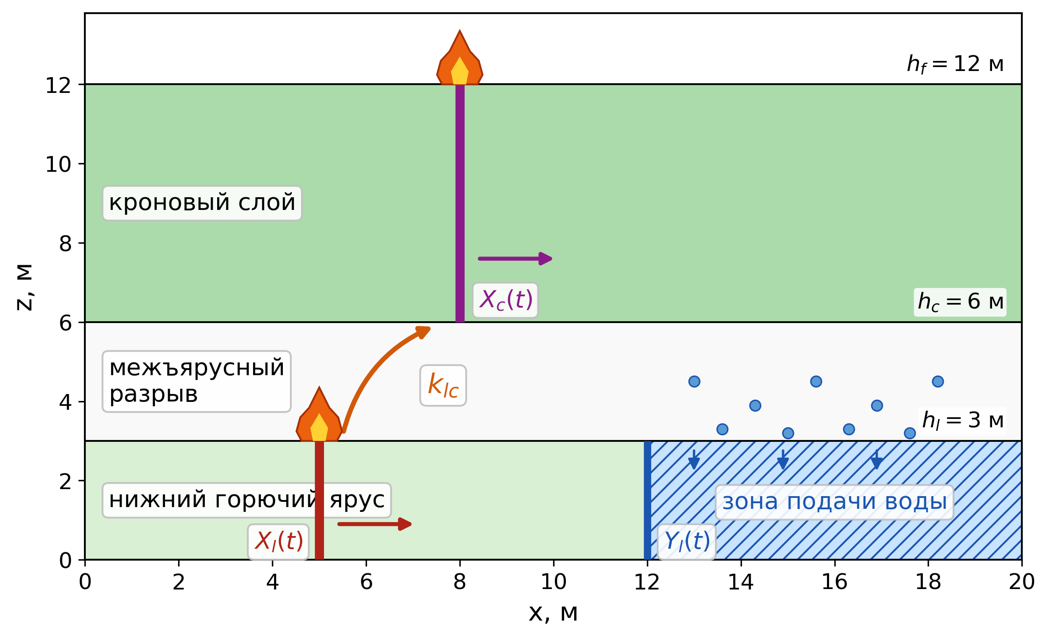
An analytical model is proposed for extinguishing a surface forest fire in a two-tier forest vegetation with an interlayer gap and preventing its transition to a crown fire. The stand is treated as a reacting porous medium with a lower combustible layer, an interlayer gap formed by tree trunks and a crown layer. Starting from the energy equation of the reacting porous medium model, in which pyrolysis, combustion, radiative and convective transfer are represented by effective sources and coefficients, a height-averaged two-tier thermal model of two one-dimensional combustion waves is derived. The analytical travelling-wave solution is obtained for the single-tier heat transfer equation with a threshold heat release term; the wave existence condition, the wave speed, the critical cooling intensity and the critical water supply are derived. The interaction of the surface front and the crown-layer combustion wave is described by an approximate two-front model. The single-tier wave speed is reproduced by direct numerical solution of the reduced equation within two percent; the limiting cases are reduced to the classical combustion wave without suppression and to the problem of combustion wave suppression by free water; a qualitative comparison with the Van Wagner criterion is performed. For the base parameters the surface wave speed is 0.0234 m/s and the critical cooling intensity of the lower tier is 3.20 K/s; within the effective coupled-wave approximation the calculated critical water supply intensity into the lower tier for the base parameters is 7.58 K/s, 2.37 times higher than for the isolated lower tier. Selective cooling of the lower layer is effective only before a self-sustained crown-layer combustion wave forms.
В статье предложена аналитическая модель тушения низового лесного пожара в двухъярусной лесной растительности с межъярусным разрывом и предотвращения его перехода в верховой. Лес рассматривается как реагирующая пористая среда, состоящая из нижнего горючего яруса, межъярусного разрыва, образованного стволами деревьев, и кронового слоя. Исходя из уравнения энергии модели реагирующей пористой среды, в котором процессы пиролиза, газофазного горения, лучистого и конвективного переноса представлены эффективными источниками и коэффициентами, получена осредненная по высоте двухъярусная тепловая модель из двух одномерных волн горения. Аналитическое решение в виде бегущей волны получено для одноярусного уравнения теплопереноса со ступенчатым источником тепловыделения; выведены условие существования самоподдерживающейся волны горения, формула скорости волны, критическая интенсивность охлаждения и критический расход воды. Взаимодействие низовой волны и волны горения в слое крон деревьев описывается приближенной двухфронтовой моделью, использующей характеристики этих волн. Численная верификация относится к одноярусному волновому решению: скорость волны воспроизводится прямым численным решением редуцированного уравнения с отклонением менее двух процентов; предельные случаи сведены к классической волне горения без тушения и к задаче о подавлении волны горения свободной водой; выполнено качественное сопоставление с критерием Ван Вагнера. Для базовых параметров скорость низовой волны составляет 0.0234 м/с, критическая интенсивность охлаждения нижнего яруса 3.20 К/с; в рамках эффективного приближения объединенной волны расчетная критическая интенсивность подачи воды в нижний ярус для базовых параметров равна 7.58 К/с, что в 2.37 раза выше, чем для изолированного нижнего яруса. Показано, что селективное охлаждение нижнего яруса эффективно только до формирования самоподдерживающейся волны горения в слое крон деревьев.
лесной пожар, верховой пожар, двухъярусный лес, волна горения, аналитическое решение
1. Stocks B.J., Alexander M.E., Lanoville R.A. Overview of the International Crown Fire Modelling Experiment // Canadian Journal of Forest Research. 2004. Vol. 34. No. 8. P. 1543-1547. 2. Bakhshaii A., Johnson E.A. A review of a new generation of wildfire-atmosphere modeling // Canadian Journal of Forest Research. 2019. Vol. 49. No. 6. P. 565-574. DOI: 10.1139/cjfr-2018-0138. 3. Van Wagner C.E. Conditions for the start and spread of crown fire // Canadian Journal of Forest Research. 1977. Vol. 7. No. 1. P. 23-34. DOI: 10.1139/x77-004. 4. Rothermel R.C. A mathematical model for predicting fire spread in wildland fuels. Ogden: USDA Forest Service, 1972. 40 p. Research Paper INT-115. 5. Scott J.H., Reinhardt E.D. Assessing crown fire potential by linking models of surface and crown fire behavior. Fort Collins: USDA Forest Service, Rocky Mountain Research Station, 2001. 59 p. Research Paper RMRS-RP-29. 6. Cruz M.G., Alexander M.E., Wakimoto R.H. Modeling the likelihood of crown fire occurrence in conifer forest stands // Forest Science. 2004. Vol. 50. No. 5. P. 640-658. 7. Cruz M.G., Alexander M.E. Modelling the rate of fire spread and uncertainty associated with the onset and propagation of crown fires in conifer forest stands // International Journal of Wildland Fire. 2017. Vol. 26. No. 5. P. 413-426. DOI: 10.1071/WF16218. 8. Sharaf M., Sutherland D., Wadhwani R., Moinuddin K. Thresholds of surface fire transition to crown fire: Effects of wind speed and crown base height with fixed moisture content // Fire Safety Journal. 2025. Vol. 158. Art. 104545. DOI: 10.1016/j.firesaf.2025.104545. 9. Гришин А.М. Физика лесных пожаров. Томск: Изд-во Томского ун-та, 1994. 207 с. 10. Гришин А.М. Математическое моделирование природных пожаров и катастроф // Вестник Томского государственного университета. Математика и механика. 2008. № 2(3). С. 105-114. 11. Гришин А.М., Перминов В.А. Переход низового лесного пожара в верховой // Физика горения и взрыва. 1990. Т. 26. № 6. С. 27-35. 12. Перминов В.А. Математическое моделирование зажигания полога леса от очага низового лесного пожара // Вычислительные технологии. 2008. Т. 13. № 5. С. 99-105. 13. Perminov V., Goudov A. Mathematical Modeling of Forest Fires Initiation, Spread and Impact on Environment // International Journal of GEOMATE. 2017. Vol. 13. No. 35. P. 93-99. DOI: 10.21660/2017.35.6704. 14. Baranovskiy N.V., Kirienko V.A. Mathematical Simulation of Forest Fuel Pyrolysis and Crown Forest Fire Impact for Forest Fire Danger and Risk Assessment // Processes. 2022. Vol. 10. No. 3. Art. 483. DOI: 10.3390/pr10030483. 15. Kataeva L.Y., Maslennikov D.A., Loshchilova N.A. On the laws of combustion wave suppression by free water in a homogeneous porous layer of organic combustible materials // Fluid Dynamics. 2016. Vol. 51. No. 3. P. 389-399. 16. Kataeva L.Y., Ilicheva M.N., Loshchilov A.A. Mathematical modeling for extinguishing forest fires using water capsules with a thermoactive shell // Journal of Applied Mechanics and Technical Physics. 2022. Vol. 63. No. 7. P. 1227-1242. DOI: 10.1134/S0021894422070069. 17. Волков Р.С., Кузнецов Г.В., Стрижак П.А. Экспериментальная оценка влияния процесса испарения капель воды на условия их перемещения во встречном потоке высокотемпературных газов // Теплофизика высоких температур. 2016. Т. 54. № 4. С. 584-589. 18. Kuznetsov G.V., Strizhak P.A., Volkov R.S., Zhdanova A.O. Amount of Water Sufficient to Suppress Thermal Decomposition of Forest Fuel // Journal of Mechanics. 2017. Vol. 33. No. 5. P. 703-711. DOI: 10.1017/jmech.2017.13. 19. Volkov R.S., Kuznetsov G.V., Strizhak P.A. Experimental Determination of the Fire-Break Size and Specific Water Consumption for Effective Containment and Complete Suppression of the Front Propagation of a Typical Local Wildfire // Journal of Applied Mechanics and Technical Physics. 2019. Vol. 60. No. 1. P. 68-79. DOI: 10.1134/S0021894419010103. 20. Nikolova E.V., Nikolova G.N., Pavlov Ts.Ch. On Wind Effects in a Hyperbolic Advection-Reaction-Diffusion Forest Fire Model: Analytical Solutions, Stability, and Bifurcation Analysis // Mathematics. 2026. Vol. 14. No. 7. Art. 1118. DOI: 10.3390/math14071118. 21. Rahman S. ur, Diaz Palencia J.L. Analytical and Computational Approaches for Bi-Stable Reaction and p-Laplacian Diffusion Flame Dynamics in Porous Media // Mathematics. 2024. Vol. 12. No. 2. Art. 216. DOI: 10.3390/math12020216. 22. Kataeva L.Y., Maslennikov D.A., Loschilov A.A., Belyaev I.V. Influence of the water barrier on the dynamics of a forest fire considering the inhomogeneous terrain and two-tier structure of the forest // ARPN Journal of Engineering and Applied Sciences. 2016. Vol. 11. No. 5. P. 2972-2980.