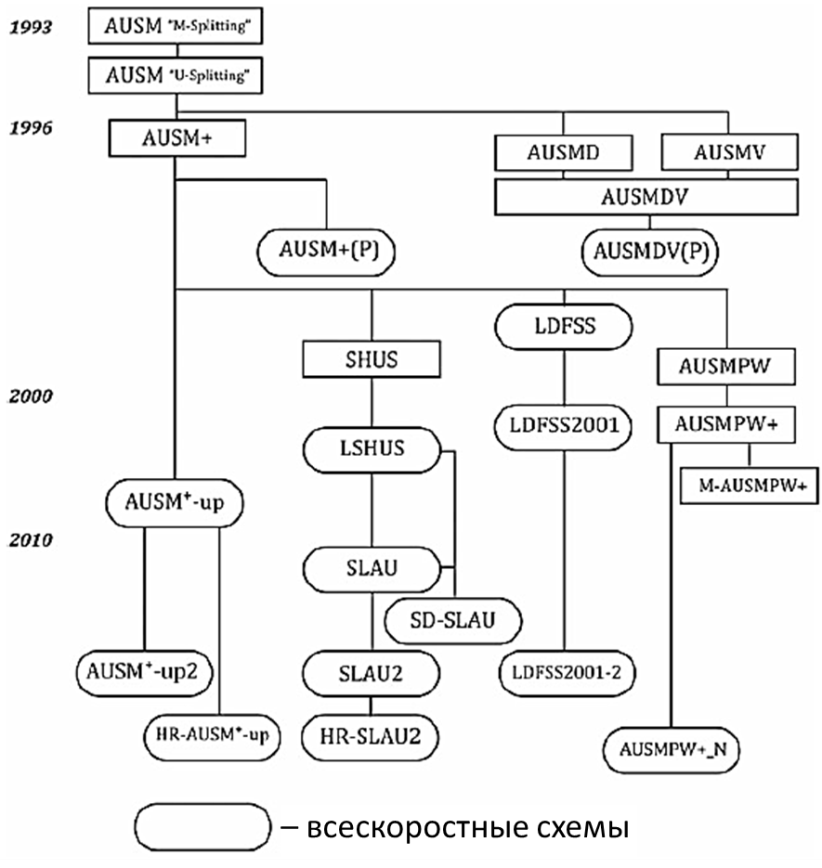
The main advantages and disadvantages of using unstructured computational grids was discussed. Various methods for solving the Riemann problem of the decay of an arbitrary discontinuity at cell boundaries are considered in the study of shock-wave interactions near the surface of high-speed aircraft. The concept of the AUSM approach and the main relationships of the algorithm are presented. The main modifications of the AUSM scheme are presented, along with their features, differences, advantages, and disadvantages.
Применение схем семейства алгоритмов AUSM при исследовании ударно-волновых взаимодействий вблизи поверхности высокоскоростных летательных аппаратов
Приведены основные достоинства и недостатки применения неструктурированных расчетных сеток. Рассмотрены различные методы решения задачи Римана о распаде произвольного разрыва на границах ячеек при исследовании ударно-волновых взаимодействий вблизи поверхности высокоскоростных летательных аппаратов. Представлены замысел подхода AUSM и основные соотношения алгоритма. Приведены основные модификации схемы AUSM, а также их особенности, различия, достоинства и недостатки.
задача Римана, контактный разрыв, ударно-волновое взаимодействие, схема AUSM, высокоскоростная аэротермодинамика
1. Albertson C.W., Venkat V.S., Shock interaction control for scramjet cowl leading edges, AIAA 2005-3289, 2005. 2. Borovoy V. Ya., Egorov I.V., Mosharov V.E., Skuratov A.S., Radchenko V.N., Extreme heating of bodies in a hypersonic flow: gas-dynamic phenomena and their characteristics, Moscow, Nauka, 2018, 390 p. [in Russian]. 3. Surzhikov S.T., Analytical methods of building finite-difference mesh for computation of aerothermodynamics of descending spacecrafts, Herald of the Bauman Moscow State Technical University Series Mechanical Engineering, 2004, no 2, pp. 24-50. [in Russian] 4. Surzhikov S.T., Calculated analysis of experimental data on the aerothermodynamics of the hypersonic aircraft HIFiRe-1. Doklady physics, 2020, vol. 65, no. 11, pp. 400-404. [in Russian] 5. Surzhikov S.T., Numerical interpretation of experimental data on aerodynamics of the HB-2 model using computer codes USTFEN and PERAT-3D, Physical-Chemical Kinetics in Gas Dynamics, 2020, vol. 21, no. 1 [in Russian]. http://chemphys.ipmnet.ru/issues/2020-21-1/articles/900/ 6. Yatsukhno D.S., Investigation of the aerothermodynamics of high-speed aircraft using perfect and real gas models, Cand. phys.-math. sci. diss., Moscow, IPMech RAS, 2019, 167 p. [in Russian] 7. Golubev A.G., Remizova O.I., Cones in ANSYS Fluent with the usage of two different methods for constructing a computational grid, Engineering Journal: Science and Innovation, 2018, vol. 83, no. 11, pp. 1-11. DOI: 10.18698/2308-6033-2018-11-1821 8. Viviani A., Pezzella G., Golia C., Aerothermodynamic Field Past a Reentry Capsule for Sample Return Missions, 28th international congress of the aeronautical sciences, 2012. 9. Lamby P., Parametric Multi-Block Grid Generation and Application to Adaptive Flow Simulations, Doctor’s degree diss., Aachen, RWTH Aachen University, 2007, 205 p. 10. Zauner M., Sandham N. D., Multiblock structured grids for direct numerical simulations of transonic wing sections, 10th International Conference on Computational Fluid Dynamics (ICCFD10), 2018. 11. Alter S.J., Weilmuenster K.J., The three-dimensional Multi-Block Advanced Grid Generation System (3DMAGGS), NASA TM-108985, 1993. 12. Assam A., Development of an Unstructured CFD Solver for External Aerothermodynamics and Nano/Micro Flows, Ph. D. thesis, Kharagpur, IIT KGP, 2019, 217 p. 13. Volkov K.N., Deryugin Yu.N., Emelyanov V.N., Karpenko A.G., Kozelkov A.S., Methods for accelerating gasdynamic calculations on unstructured grids, Moscow, Fizmatlit, 2014, 536 p. [in Russian] 14. Koryukov I.A., Kryukov I.A. Three-dimensional calculation of the aerothermodynamics of a double cone 25°/55° on an unstructured grid // Journal of Physics: Conference Series. 2018. Vol. 1009, p. 012003. 15. Figueira da Silva L.F., Azevedo J.L.F., Korzenowski H., Unstructured Adaptive Grid Flow Simulations of Inert and Reactive Gas Mixtures, Journal of Computational Physics, 2000, vol. 160, no. 2, pp. 522 540. 16. Pirzadeh S.Z., Advanced Unstructured Grid Generation for Complex Aerodynamic Applications, AIAA Journal, 2010, vol. 48, no. 5, pp. 904-915. 17. Bessonov O., Efficient Cluster Parallelization Technology for Aerothermodynamics Problems, Parallel Computing Technologies, Cham, Springer International Publishing, 2021, pp. 153–165. DOI:10.1007/978-3-030-86359-3_12 18. Batina J.T., Lee E.M., Kleb W.L., Rausch R. D., Unstructured-grid methods development for unsteady aerodynamic and aeroelastic analyses, NASA Langley Research Center, 1991. 19. Bonfiglioli A., Paciorri R., Hypersonic Flow Computations on Unstructured Grids: Shock-Capturing vs. Shock-Fitting Approach, 40th Fluid Dynamics Conference and Exhibit, AIAA 2010-4449, 2010. 20. Isaev S.A., Baranov P.A., Gortyshov Yu.Ph., Guvernyuk S.V., Mazo A.B., Smurov M.Yu., Sudakov A.G., Usachov A.E., Kharchenko V.B., Aerodynamics of thickened bodies with vortex cells. Numerical and physical modeling, Saint Petersburg, Politekhnicheskii universitet, 2016, 215 p. 21. Gnoffo P., White J., Computational Aerothermodynamic Simulation Issues on Unstructured Grids, 37th AIAA Thermophysics Conference, 2004. 22. Tahmasbi V., Karimian S., A New Algorithm for Shock Sensor Calculation at Supersonic Speeds on a 3D-Unstructured Grid, J. Aerosp. Technol. Manag., 2016, vol.8, no. 4, pp.441-450. 23. Mavriplis D.J., Unstructured-Mesh Discretizations and Solvers for Computational Aerodynamics, AIAA Journal, 2008, vol. 46, no. 6, pp. 1281-1298. 24. Bonfiglioli A., Paciorri R., Comparative Study of Stagnation Point Anomalies by Means of Shock Capturing and Shock Fitting Unstructured Codes, Sixth European Symposium on Aerothermodynamics for Space Vehicles, 2009. 25. Mazaheri A.R., Kleb B., Exploring Hypersonic. Unstructured-Grid Issues through Structured Grids, AIAA 2007-4462, 2007. 26. Voronich I.V., Smirnova N.S., Titarev V.A., Algorithm for Mesh Adaptation to a Flow Field with a Bow Shock Wave, Comput. Math. and Math. Phys., 2024, vol. 64, pp. 2111–2120. 27. Peter J., Nguyen-Dinh M., Trontin P., Goal oriented mesh adaptation using total derivative of aerodynamic functions with respect to mesh coordinates – With applications to Euler flows, Computers & Fluids, 2012, vol. 66, pp. 194-214. 28. Peraire J., Peiró J., Morgan K., Hassan O., The computation of aerodynamic flows using unstructured meshes, The finite element method in the 1990’s, Heidelberg, Springer Berlin, 1992, pp. 452–464. 29. Edwards J.E.H., Adaptive Quadrilateral and Triangular Finite‑Element Scheme for Compressible Flows, AIAA Journal, 1990, vol. 28, no. 1, pp. 51–59. 30. Schwing A.M., Nompelis I., Candler G.V., Implementation of Adaptive Mesh Refinement in an Implicit Unstructured Finite-Volume Flow Solver, 21st AIAA Computational Fluid Dynamics Conference, 2013. 31. Nguyen-Dinh M., Peter J., Sauvage R., Meaux M., Desideri J.-A., Mesh quality assessment based on aerodynamic functional output total derivatives, European Journal of Mechanics B/Fluids, 2013. 32. Kotov D.V., Surzhikov S.T., Computations of viscous and nonviscous gas flows on unstructured grids using AUSM, Computational continuum mechanics, 2011, vol. 4, no. 1, pp. 36-54. [in Russian] https://doi.org/10.7242/1999-6691/2011.4.1.4 33. Kotov D.V., Surzhikov S.T., Calculation of hypersonic flow of reacting gas in scramjet combustor by finite volume method using AUSM, Physical-Chemical Kinetics in Gas Dynamics, 2011, vol. 11. [in Russian] http://chemphys.ipmnet.ru/issues/2011-11/articles/174/ 34. Surzhikov S.T., Ponomarev E.P., Finite volume method for solving problems of continuum mechanics and radiative heat transfer, Preprint No. 645, Ishlinsky Institute for Problems in Mechanics RAS, 1999, 24 p. [in Russian] 35. Sakovich V.S., Sorokin A.M., Application of unstructured grids for computing a viscous flow around multi-element airfoils, Zhurnal Vychislitel'noi Matematiki i Matematicheskoi Fiziki, 1997, vol. 37, no. 10, pp. 1269–1280. [in Russian] 36. Godunov S. K., Numerical Solution of Multidimensional Problems in Gas Dynamics, Moscow, Nauka, 1976, 400 p. [in Russian] 37. Godunov S.K., A finite difference method for the computation of discontinuous solutions of the equations of fluid dynamics, Sbornik: Mathematics, 1959, vol. 47, no. 8-9, pp. 357-393. [in Russian] 38. Zheleznyakova A.L. An efficiency analysis of modern numerical schemes for solving the problem of the decay of an arbitrary discontinuity within the framework of the method of splitting by physical processes for the computations of hypersonic flows, Physical-Chemical Kinetics in Gas Dynamics, 2014, vol. 15, no. 5. [in Russian] http://chemphys.ipmnet.ru/issues/2014-15-5/articles/255/ 39. Harten A., Lax P., van Leer B., On upstream differencing and Godunov type methods for hyperbolic conservation laws, SIAM review, 1983, vol. 25, pp. 35–61. 40. Toro E.F., Spruce M., Speares W., Restoration of the contact surface in the HLL Riemann solver, J. Shock Waves, 1994, vol. 4, pp. 25–34. 41. Toro B.F., Chakraborty A., Development of an approximate Riemann solver for the steady supersonic Euler equations, The Aeronautical Journal, 1994, vol. 98, pp. 325–339. 42. Rusanov V.V., The calculation of the interaction of non-stationary shock waves with barriers, Zhurnal Vychislitel'noi Matematiki i Matematicheskoi Fiziki, 1961, vol. 1, no. 2, pp. 267–279. [in Russian] 43. Roe P.L., Approximate Riemann solvers, Parameter Vectors, and Difference Schemes, J. Comput. Phys., 1981,vol. 43, pp. 357–372. 44. Engquist B., Osher S., One-sided difference approximations for nonlinear conservation laws, Math. Comp., 1981, vol. 36, no. 154, pp. 321–351. 45. Osher S., Solomon F., Upwind difference schemes for hyperbolic systems of conservation laws, Math. Comp., 1982, vol. 38, no. 158, pp. 339–374. 46. Osher S., Chakravarthy S.R., Upwind schemes and boundary conditions with applications to Euler equations in general geometries, J. Comput. Phys., 1983, vol. 50, pp. 447–481. 47. Steger J.L., Warming R.F., Flux vector splitting of the inviscid gasdynamic equations with application to finite-difference methods, J. Comput. Phys., 1981, vol. 40, pp. 263–293. 48. van Leer. B., Flux–Vector Splitting for the Euler Equations, ICASE Report 82–30, 1982. 49. van Leer. B., Flux Vector Splitting for the Euler Equations, Proc. 8th International Conference on Numerical Methods in Fluids Dynamics, 1982, pp. 507–512. 50. Liou M.S., Steffen C.J., A new flux splitting scheme, Journal of Computational physics, 1993, vol. 107, no. 1, pp. 23–39. 51. Liou M.S., A Sequel to AUSM: AUSM+, Journal of Computational Physics, 1996, pp. 364-382. 52. Wada Y., Liou M.S., An accurate and robust flux splitting scheme for shock and contact discontinues, SIAM J. Scientific Computing, 1997, pp. 633-657. 53. Liou M.S., Recent progress and applications of AUSM+, Sixteenth International Conference on Numerical Methods in Fluid Dynamics, 1998, vol. 515, pp. 302–307. 54. Liou M.S., A Sequel to AUSM, Part II: AUSM+-up, Journal of Computational Physics, 2006, pp. 137-170. 55. Kim K.H., Lee J.H., Rho O.H. ,An improvement of AUSM schemes by introducing the pressure-based weight functions, Computers & fluids, 1998, vol. 27, no. 3, pp. 311-346. 56. Kim K.H., Kim C., Rho O.H., Methods for the Accurate Computations of Hypersonic Flows I. AUSMPW+ Scheme, Journal of Computational Physics, 2001, vol. 174, no. 1, pp. 38-80. 57. Chang C.H., Liou M.S., A New approach to the simulation of compressible multifluid flows with AUSM+ scheme, 16th AIAA CFD Conference, AIAA Paper 2003-4107, 2003. 58. Edwards J.R., Franklin R., Liou M.S., Low-Diffusion Flux-Splitting Methods for Real Fluid Flows with Phase Transitions, AIAA Journal, 2000, vol. 38, no. 9, pp. 1624-1633. 59. Edwards J.R., Liou M.S., Low-diffusion flux-splitting methods for flows at all speeds, AIAA Journal, 1998, vol. 36, no. 9, pp. 1610-1617. 60. Peery K.M., Imlay S.T., Blunt Body Flow Simulations, AIAA Paper 88-2924, 1988. 61. Liou M.S., Ten Years in the Making: AUSM-Family, AIAA 2001-2521, 2001. 62. Liou M.S., Wada Y., A Flux Splitting Scheme with High-Resolution and Robustness for Discontinuities, AIAA Paper 94-0083, 1994. 63. Billet G., Louedin O., Adaptive limiters for improving the accuracy of the MUSCL approach for unsteady flows, Journal of Computational Physics, 2001, vol. 170, no. 1, pp. 161-183. 64. Shima E., Kitamura K., Parameter-free simple low-dissipation AUSM-family scheme for all speeds, AIAA Paper 1693-1709, 2011. 65. Kitamura K., Shima E., A new pressure flux for AUSM-family schemes for hypersonic heating computations, 20th AIAA Computational Fluid Dynamics Conference, 2011, pp. 3056. 66. Kitamura K., Shima E., Towards shock-stable and accurate hypersonic heating computations: A new pressure flux for AUSM-family schemes, Journal of Computational Physics, 2013, vol. 245, pp. 62 83. 67. Kitamura K., Liou M.S., Chang C.H., Extension and Comparative Study of AUSM-Family Schemes for Compressible Multiphase Flow, Communications in Communications in Computational Physics, 2014, vol. 16, no. 3, pp. 632-674. 68. Kitamura K., Assessment of SLAU2 and other flux functions with slope limiters in hypersonic shock-interaction heating, Computers & Fluids, 2016, vol. 129, pp. 134-145. 69. Chen S., Cai F., Xue H., Wang N., Yan C., An improved AUSM-family scheme with robustness and accuracy for all Mach number flows, Applied Mathematical Modelling, 2019. 70. Singh R., Holmes G., Evaluation of an artificial dissipation and AUSM based flux formulation: AD–AUSM, AIAA Paper 2000-3069, 2012. 71. Chen S.-S., Yan C., Zhong K., Xue H.-C., Li, E.-L., A novel flux splitting scheme with robustness and low dissipation for hypersonic heating prediction, Int. J. of Heat and Mass Transfer, 2018, vol. 127, pp. 126–137. 72. Kitamura K., Advancement of Shock Capturing Computational Fluid Dynamics Methods: Numerical Flux Functions in Finite Volume Method, Singapore, Springer Nature, 2020, 142 p. 73. Sod G.A., A survey of several finite difference methods for systems of nonlinear hyperbolic conservation laws, Journal of Computational Physics, 1978, vol. 27, pp. 1–31. 74. Lax P.D., Liu X.D., Solution of two-dimensional Riemann problems of gas dynamics by positive schemes, SIAM Journal on Scientific Computing, 1998, vol. 19, pp. 319–340. 75. Zheleznyakova A.L., Surzhikov S.T. Application of the method of splitting by physical processes for the computation of a hypersonic flow over an aircraft model of complex configuration, High Temp, 2013, vol. 51, pp. 816–829. 76. Belotserkovskii O.M., Davydov Yu.M., Method of Large Particles in Gas Dynamics, Moscow, Nauka, 1982, 391 p. [in Russian] 77. Kryukov I.A., Ivanov I.E., Larina E.V., Verification of the hysol software package for calculating high-speed flows, Materialy XX Yubilejnoj mezhdunarodnoj konferencii po vichislitelnoj mekhanike I sovremennym prikladnym programmnym sistemam (VMSPPS 2017), Moscow, Izdatelstvo MAI-Print, 2017. [in Russian] 78. Silvestrov P.V., Determination of the aerodynamic characteristics of advanced aircraft using a set of proprietary computer codes, Cand. phys.-math. sci. diss., Moscow, IPMech RAS, 2021, 257 p. [in Russian] 79. Koryukov I.A., Numerical modeling of shock-wave interactions in high-speed gas flows, Cand. phys. math. sci. diss., Moscow, IPMech RAS, 2026, 146 p. [in Russian] 80. Ishin D.V. Numerical modeling of shock waves interference interaction near a plate with cylindrical bluntness, Physical-Chemical Kinetics in Gas Dynamics, 2026, vol. 27, no. 3 [in Russian]. http://chemphys.ipmnet.ru/issues/2026-27-3/articles/1281/